
 Famous Faces, Famous Places and Famous Foods

Down Havana Way
Habana, like a beautiful Creole mistress down on her luck is full of secret alleys that she will lead you down, and worn beauty that is capable of anything. And even though she is down and out, and although her once exquisite clothing is ripped and torn -- her elegance, beauty, artistic soul and her heart still shines brilliant as the light of the Caribbean moon.
Café Society in La Habana Vieja
Dearest reader: I would like to give you my impressions of Havana, Cuba. It seems a most unusual place with little US influence. The architecture is splendid, although some in falling down disarray. We are only here for a few short days -- but found it so completely fascinating I knew I had to tell you about it.
Havana (pronounced Habana) is best seen by wandering leisurely about the old city (La Habana Vieja -- she is female) enjoying the café society life much like Ernest Hemingway would have during the 1940s and '50s and his love affair with this brightly intelligent, artistic and cultured island.
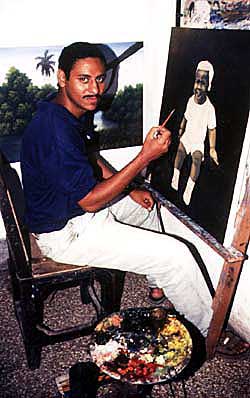 La Habana Vieja is a bohemian place of art, music, platform shoes, and skin tight lycra clothes as brightly colored as the ochre-colored building with blue-edged shutters that house the cafés. Patrons drink cerveza, tucola or mojitos while swaying hips and shoulders to Cuban love songs and Latin rhythms. The tucola (Cuban Coca Cola) tastes great and the people want to talk (and sell you something in some cases).
Cuban musicians play (Cubans study art, music and literature in school) Salsa and Latin love songs from morning ’till late night, every day of the week. The music wafts through the air along with the smell of fresh Cuban coffee and freshly rolled Habana cigars. Patrons, both male and female wander from café to café -- in search of their favorite musical groups.
Outside the cafés a parade of life strolls by -- as brilliant and diverse as birds in a rainforest. The buildings along the narrow twisting streets are painted up like tropical butterflies and everywhere someone is kissing.
 The young women who loiter by the cafés seem to favor lycra clothing in Day-Glo colors (the better to be noticed) and platform shoes. These women are often prostitutes, or paid companions -- selling their company, or a dance. Both women and men of all races mix freely together and there seems to be no color bar.
Men from all walks of life, who haven’t the money to enjoy musica or mojitos (a refreshing drink of mint, sugar, light rum and soda) wait patiently outside the cafés in the hope of selling tourists a cigar, a tour to the factory, or an evening of dining in their homes. (Since the fall of Communist Russia, Fidel Castro has no financial backer to fuel his social programs that went with the Revolution. The US embargo and lack of Cuban goods has made even small purchases out of reach for most Cubans. School teachers, physicians and lawyers have left their chosen professions that pay so little in comparison with the price of goods -- they can barely feed their families. Instead they have taken to selling what ever they can to the tourists in the streets for the almighty US Dollar.)
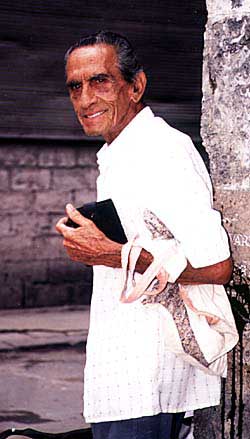
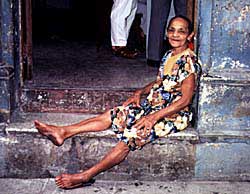 If you wander in the old quarter of Habana, you will be approached by people asking for US dollars. These beggars are usually children and old women -- but they are happy with soap, shampoo, pens and even tea. There is obvious poverty, but no one looks ill or starving. The failing state-controlled economy still manages to provide free medical care to all its citizens and although they must stand in line -- every Cuban receives a small ration of basic food -- but only when available.
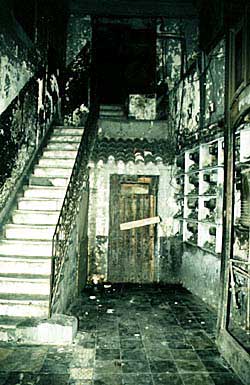 Today, Habana is poor -- but certainly not in spirit. But certainly, she is frozen in a time warp. The Spanish-style rococo buildings are an elegant sight out of a different era, as are the old 1950s American sedans, the cars washed and shiny as a newly minted American coin.
The Malecon has little motorized traffic except for a small number of American cars (pre 1959), and Russian vehicles (pre the collapse of the Soviet Union) and pedicabs. Buildings whose fretted, faded exteriors are still washed in sunset yellows, pinks, and orange -- line this famous street and promenade that fronts the sea.
The architecture of the Malecon, once the pride of the Americas, is now a shadow of its former self. Intricately crafted buildings are still beautiful on the outside, but in such a state of utter disrepair it looks almost as if they are a façade -- or a figment out of someone's long forgotten dream.
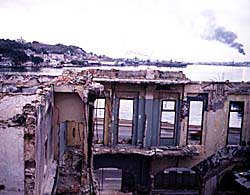 It is easy to imagine the highlife from the days when Cuba was the paradise island for wealthy travelers, even wealthier American sugar barons; and then the degradation that ensued in the time of the corrupt (and American backed) President Batista. (Batista cut deals and sold his country out to American gangsters, thugs and Mafia -- before Fidel Castro and his 1959 Revolution.)
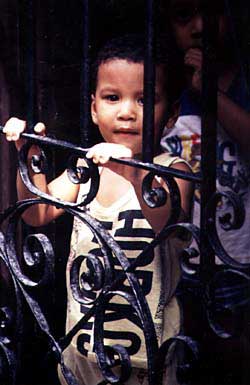 Some Cubans are forced by poverty to live in these derelict buildings that were once inhabited by the wealthy and privileged. Picture a child, one storey above the ground, bare brown elbows and hands against a black wrought iron balcony gazing dreamily. The sporadic passing of vehicles on the rain washed street below go unnoticed; a gray Russian Lada truck; a single apple-red Chrysler; a trail of exhaust belching to sea. The child could be dreaming of an uncle, or sister who left home on a raft to cross the ninety miles of ocean to Key West and the lure of a better life…The child leans wistfully over the famous oceanfront street and promenade, the Malecon. On the cement wall of the Malecon life parades on -- fishermen throw their lines into the sea, school children in pressed uniforms hold hands and stroll, and lovers lie in each others arms.
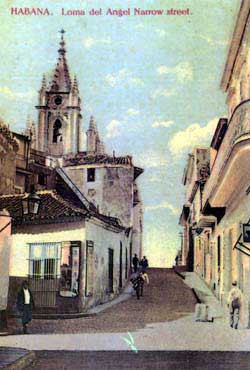 Dear reader, it is hard for me to know if you will find Habana as fascinating as I do. And those of you who have an aversion to seeing poverty, or dirt, or flies -- certainly shouldn't go. But Havana is for those who crave to get lost in a city made of elusive human dreams. And it is magic for those who want to wander down alleys that go nowhere -- but everywhere… And it is for those who know life is made of picture postcards.
Sent to you from Habana on the wings of a dove and with all appropriate affection!
PS: It seems a place of Rococo churches; old American cars and Russian trucks; and museums with tanks and rocket launchers. It seems a place edged with sensuality. I think Cuba might be the Vietnam of the Caribbean -- a fascination in a Time Warp.
PPS: If you do get to Cuba and are interested in history -- you will find thirteen museums. One, the Museo of the Ministry of the Interior, is dedicated to the inept deeds done to Cuba by the CIA.
For information on Cuba contact Cuba Tourist Board in Canada at (416) 362-0700. Or visit: www.cubatravels.cu
To read about Cuba or research a trip, the Cuba Handbook (Moon Travel Handbooks), by Christopher P. Baker, takes a sensitive, honest and unbiased approach to Cuba's fascinating history (the fascination is ongoing) and America's role in Cuba (also ongoing). You won't be able to put it down!
 From Moon Travel Handbooks:
Cuba Handbook
By Christopher P. Baker
1st edition 1980, 740 pages, 64 maps
 Paperback - Order from Amazon
 Today, Habana is poor -- but certainly not in spirit. But
certainly, she is frozen in a time warp. The Spanish-style rococo buildings are an elegant
sight out of a different era, as are the old 1950s American sedans, the cars washed and
shiny as a newly minted American coin.
Today, Habana is poor -- but certainly not in spirit. But
certainly, she is frozen in a time warp. The Spanish-style rococo buildings are an elegant
sight out of a different era, as are the old 1950s American sedans, the cars washed and
shiny as a newly minted American coin.
The Malecon has little motorized traffic except for a small number of American cars (pre 1959), and Russian vehicles (pre the collapse of the Soviet Union) and pedicabs. Buildings whose fretted, faded exteriors are still washed in sunset yellows, pinks, and orange -- line this famous street and promenade that fronts the sea.
The architecture of the Malecon, once the pride of the Americas, is now a shadow of its former self. Intricately crafted buildings are still beautiful on the outside, but in such a state of utter disrepair it looks almost as if they are a façade -- or a figment out of someone's long forgotten dream.
 It is easy to imagine the highlife from the days when Cuba was the
paradise island for wealthy travelers, even wealthier American sugar barons; and then
the degradation that ensued in the time of the corrupt (and American backed) President
Batista. (Batista cut deals and sold his country out to American gangsters, thugs and
Mafia -- before Fidel Castro and his 1959 Revolution.)
It is easy to imagine the highlife from the days when Cuba was the
paradise island for wealthy travelers, even wealthier American sugar barons; and then
the degradation that ensued in the time of the corrupt (and American backed) President
Batista. (Batista cut deals and sold his country out to American gangsters, thugs and
Mafia -- before Fidel Castro and his 1959 Revolution.)
 Some Cubans are forced by poverty to live in these
derelict buildings that were once inhabited by the wealthy and privileged. Picture a
child, one storey above the ground, bare brown elbows and hands against a black wrought
iron balcony gazing dreamily. The sporadic passing of vehicles on the rain washed street
below go unnoticed; a gray Russian Lada truck; a single apple-red Chrysler; a trail of
exhaust belching to sea. The child could be dreaming of an uncle, or sister who left home
on a raft to cross the ninety miles of ocean to Key West and the lure of a better
life…The child leans wistfully over the famous oceanfront street and promenade, the
Malecon. On the cement wall of the Malecon life parades on -- fishermen throw their lines
into the sea, school children in pressed uniforms hold hands and stroll, and lovers lie in
each others arms.
Some Cubans are forced by poverty to live in these
derelict buildings that were once inhabited by the wealthy and privileged. Picture a
child, one storey above the ground, bare brown elbows and hands against a black wrought
iron balcony gazing dreamily. The sporadic passing of vehicles on the rain washed street
below go unnoticed; a gray Russian Lada truck; a single apple-red Chrysler; a trail of
exhaust belching to sea. The child could be dreaming of an uncle, or sister who left home
on a raft to cross the ninety miles of ocean to Key West and the lure of a better
life…The child leans wistfully over the famous oceanfront street and promenade, the
Malecon. On the cement wall of the Malecon life parades on -- fishermen throw their lines
into the sea, school children in pressed uniforms hold hands and stroll, and lovers lie in
each others arms.
 Dear reader, it is hard for me
to know if you will find Habana as fascinating as I do. And those of you who have an
aversion to seeing poverty, or dirt, or flies -- certainly shouldn't go. But Havana is
for those who crave to get lost in a city made of elusive human dreams. And it is
magic for those who want to wander down alleys that go nowhere -- but everywhere… And
it is for those who know life is made of picture postcards.
Dear reader, it is hard for me
to know if you will find Habana as fascinating as I do. And those of you who have an
aversion to seeing poverty, or dirt, or flies -- certainly shouldn't go. But Havana is
for those who crave to get lost in a city made of elusive human dreams. And it is
magic for those who want to wander down alleys that go nowhere -- but everywhere… And
it is for those who know life is made of picture postcards.
Sent to you from Habana on the wings of a dove and with all appropriate affection!
PS: It seems a place of Rococo churches; old American cars and Russian trucks; and museums with tanks and rocket launchers. It seems a place edged with sensuality. I think Cuba might be the Vietnam of the Caribbean -- a fascination in a Time Warp.
PPS: If you do get to Cuba and are interested in history -- you will find thirteen museums. One, the Museo of the Ministry of the Interior, is dedicated to the inept deeds done to Cuba by the CIA.
For information on Cuba contact Cuba Tourist Board in Canada at (416) 362-0700. Or visit: www.cubatravels.cu
To read about Cuba or research a trip, the Cuba Handbook (Moon Travel Handbooks), by Christopher P. Baker, takes a sensitive, honest and unbiased approach to Cuba's fascinating history (the fascination is ongoing) and America's role in Cuba (also ongoing). You won't be able to put it down!
From Moon Travel Handbooks:
Cuba Handbook
By Christopher P. Baker
1st edition 1980, 740 pages, 64 maps
Paperback - Order from
Amazon