
 Famous Faces, Famous Places and Famous Foods

Christmas at the End of the World
"Feliz Navidad!" said the LAPA stewardess as I stepped off the plane at the Ushuaia airport. It was a strange burst of cheer from an airline that had just delivered me 2,000 miles without offering me so much as a bag of peanuts. But I didn't care; I had finally made it to Tierra del Fuego. The end of the world. Even from the tarmac I could see the snow-capped peaks of the southern Andes.
I had come from my temporary home in Buenos Aires to spend Christmas in Ushuaia: the southernmost city in the world. Why? There is a beautiful simplicity about Tierra del Fuego. There are exactly six species of tree in the whole province. You can see whales, and you can see penguins; anything else is gravy. And there is only one town worth staying in – Ushuaia.
I walked outside the terminal. After the stuffy summer air of Buenos Aires, the pure, cool oxygen-rich air of Tierra del Fuego hit me like a drug. A five-minute taxi ride brought me to the center of town.
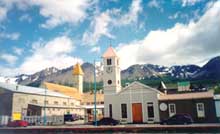 Traveling solo can be a lonely affair, especially during the holidays, so I opted for a hotel which my guidebook described as a "good meeting place." The "International Lodging," was the rather grand title for what turned out to be a single-family concrete house with kitchen and bath shared among guests and family members.
The owner, Anna, was in the communal kitchen, which was clean in that I-guess-it-won't-kill-me kind of way. Table scraps were generally pushed on to the floor, for the nourishment of two small kittens.
I introduced myself and explained that I had phoned ahead. Anna looked at me as though trying to decide which species I belonged to. "There are no rooms," she said.
"But—"
"You'll have to take my bedroom," she said abruptly. I protested, but Anna insisted. Besides, she explained, it wasn't really her bedroom, but just a room she retreated to when her husband, Pablo, drank too much.
"Don't worry," Anna said, "He hasn't been drinking too much lately." Somehow, I interpreted that as "he's due for a bender any day now." I took the room anyway, it was large and had an excellent view of the Beagle Channel – named for the ship that brought Charles Darwin to these parts in 1833.
I changed my clothes and prepared to do some sightseeing. Before I could reach the door Anna pulled me aside for a chat. She turned out to be one of those innkeepers who saw herself as a surrogate mother to young travelers. And she held on to a conversation with the tenacity of a New York cabby.
She talked to me about her husband's drinking -- the arguments, the tears, the rehab. Soon I knew far more about Anna's marital life than about my own sister's. Eventually the conversation worked its way to Anna's personal savior, Our Lord, Jesus Christ of Nazareth. Had I been born again?
"No, just the once."
Anna gave me some sightseeing tips and let me be on my way.
* * *
Later that day, I met up with a friend of a friend from Buenos Aires. His name was Humberto and he was a psychologist practicing in Ushuaia. He had plenty of work with the drifters, drug addicts, and Bolivians who had stopped in Ushuaia because there was no where else to go. In the winter, when the nights were 18 hours long, his caseload doubled.
Humberto asked where I was staying. I told him. He said that he knew the place.
"And do you know Anna?" I asked.
"Oh yes," he said cheerfully. "She's one of my patients."
* * *
The next day was Christmas. I teamed up with one of the other guests, a young Swiss architect named Max, for a trek in the Tierra del Fuego National Park. We took a bus to the Chilean border and hiked back along the Beagle Channel.
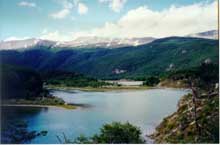
The forests of Tierra del Fuego seem to be lifted from the set of a science fiction movie. The trees are permanently bent into threatening shapes from the fierce winds. Under foot, the phosphorescent moss forms a luminous carpet. The only bit of contrast comes from a tree fungus known as Pan de los Indios ("Bread of the Indians"), which grows into bright orange globes that look like the spore-emitting pods from a "Star Trek" episode. I half-expected Max to turn around and say, "What's gotten into you, Bones? You're not yourself."
 As it happened, it was Max who behaved like an alien creature. Already possessed of excessive Teutonic reserve, he grew mysteriously chilly toward me and finally stopped speaking altogether. I don't know what alienated him; perhaps it was my refusal to accept his offer to pay for the bus ride back ("I couldn't possibly take money looted from Holocaust victims.") The Swiss are terribly sensitive.
* * *
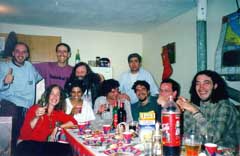
Back at the lodging, Anna's husband Pablo (a gregarious fellow who hadn't bathed since the last coup) was orchestrating a Christmas barbecue. Gradually, all the guests (except Max) got involved in the preparations. We were an odd group: three Swiss backpackers, three Italian motorcyclists, three Israelis just finished with military service, Anna, Pablo, one of the neighbors (a glazier called Norberto) – and me.
The Italian motorcyclists had come prepared. They decorated the table with a Christmas-theme paper tablecloth and plastic plates and cutlery. They even had a stocking full of candies, including a marshmallow lump of coal. "In Italy, bad kids get carbon for Christmas," one of them warned.
The table was set with large bowls of fresh salad, and crusty baguettes, fresh from the panadería. We sat down and Anna said grace. Pablo came in from the barbecue and distributed lamb, spare ribs, and chicken – charred and flecked with dirt, but inexplicably good after a day of hiking. The food was washed down with an endless supply of cheap Argentine red wine. At midnight, bottles of chilled sparkling cider were popped and Pablo made crepes filled with dulce de leche, the Argentine caramel. Norberto brought over a box of pastries he'd bought at the bakery and a bottle of Tia Maria.
One of the Israelis was an olive-skinned beauty. Norberto couldn't take his eyes off her. "Look at her skin," he whispered to me. "I used to have an Israeli girlfriend when I lived in Cordoba. She had skin just like that." He still remembered the day she went back to Israel, when they had made rash promises to keep in touch and, perhaps, more.
"What happened?"
"After the Six Day War, I never heard from her again," he said. And then drained his glass and said no more.
Eventually we brought all the booze out to the back garden, which was reached by climbing out a window and scrambling down a pile of bricks. Pablo built a bonfire and toasts were made in honor of every conceivable cause.
As the conversation got increasingly drunken, the leader of the Israeli group, a tall enthusiastic engineer, tried to create a kind of Esperanto for the party by combining bits of Spanish, Italian, and English. His main conversational tactic was blindly to affirm everything that everyone said. When Pablo offered him wine, the Israeli would shout "Si! Si! Yes, good, bueno."
"What about the insects in your glass?"
"Oh yes! Si, good – molto allegro!"
"I'm going to marry your sister!"
"Si, si, bueno -- merry Christmas to you too."
Pablo got fed up with this. "Look here," he said in English, "don't try to speak Spanish. You don't understand it."
"No, no!" said the Israeli, "I understand todo, tutti."
"Okay," Pablo said in Spanish, "suck my – "
"Good, good, molto bene!"
* * *
I got stuck in another conversation with Anna, just as I was hoping to go to bed. She had a rather interesting theology. In contrast to the conventional Christian idea that the New Testament had completed, or fulfilled the Old Testament, Anna believed that the New Testament had effectively repealed the Hebrew Bible. "Many people still read the Old Testament," she informed me. "This is very strange. They must not know that now there is a New Testament." I looked nervously toward the Israelis, but they were busy dressing up to go to Ushuaia's only discotheque.
Anna made a concerted effort to convert me with what I took to be a laying-on of hands. As the laying-on became more intense, I began to get suspicious. When she suggested that we take things into the other room, I made my excuses and stumbled off to bed.
I woke up on the 26th with a thumping headache. Through the cloud of a hangover, I looked back on our squalid little Christmas dinner with contempt. I lay in bed, composing the following song to remember Christmas of 1998. It goes to the tune of "Silver Bells."
Dirty Linens,
Scrawny Kittens,
Share the table with me,
And Saint Anna keeps putting her hand on my knee.
Sulky Swiss guy,
With a big sigh,
Brings a holiday funk,
And the evening is just under way . . .
Pablo smells,
I'm in hell,
It's Christmas time in Ushuaia.
Ring-a-ling,
Hear them sing,
Soon you'll regret that you stayed.
A tad negative, I suppose. But the pain of the morning after always demolishes the false bonhomie of the night before. And what could be more false – I said to myself – than the wine-fueled cheer of this mismatched group? I missed America, I missed friends and family.
I opened the window and breathed the fresh air. The sun was already high above the Andes. I drank from my bottle of mineral water. My headache began to recede.
Okay, maybe the evening hadn't been so bad. It wasn't a Bing Crosby Christmas, but what did I expect coming to Tierra del Fuego – a land that had been populated by missionaries, hardened criminals, sailors, and gold prospectors?
 There is a fraternity among travelers and drifters; Anna, Pablo, and other guests belonged to it. They were taking big risks with their lives: Anna and Pablo, by opening a lodging on the outskirts of Antarctica, the others by traveling the world with backpacks. I, on the other hand, was just taking a short break from my furnished apartment in Buenos Aires. And yet, I had been accepted into the fraternity, toasted and fêted like a real-life adventurer.
Pablo burst into my room, wild-eyed.
"Hey, a big cruise ship just docked in the Channel and you're room has the best view. Mind if we come take a look?"
Before I could answer, the others filed into my bedroom, carrying mugs of fresh coffee. One of them was for me.
More Information
I. Getting to Ushuaia
Most travelers will fly to Ushuaia. Almost all international flights connect through Buenos Aires. From Buenos Aires ("Aeroparque Jorge Newberry"), Aerolíneas Argentinas and LAPA fly to Ushuaia, with stops in Trelew and/or Rio Gallegos.
Those coming via Chile can fly DAP or Lan Chile from Punta Arenas, or Alta from Puerto Natales.
To go by bus-and-ferry, one must travel through Chile. Los Carlos bus company makes the 14-hour trip from Punta Arenas.
II. Where to Stay
On the luxury end (rooms over $200), Hotel del Glacier is a modern hotel that has been highly recommended. It is 3.5 km from the center on the road to the Martial Glacier. Tel. (0901) 30640; Fax (0901) 30636.
A moderate hotel in the center of town is Hotel César, San Martín 753 (single room for $50, including breakfast). Tel. 21460; Fax (0901) 32721.
For budget accommodation, the Alojamiento Internacional, Deloqui 395, offers private rooms with shared bath and kitchen facilities ($20). Tel. (0901)23622/23483.
At Lago Escondido, Hostería Petrel, (0901) 33569.
III. Where to Eat
La Cabana Casa de Té, Camino del Martial 4.5. Excellent coffee, teas, chocolate, and homemade pastries, all with a view of the Martial Glaciar.
Barcleit 1912, Fadul 148. Good pizza and pastas.
Bar Ideal, San Martín 393. Set in an attractive English-style house, good local trout, in addition to pizzas and empanadas.
Café la Esquina, San Martin y 25 de Mayo, a comfortable confitería.
IV. What to Do
Details about all excursions can be obtained at the extremely helpful tourist information office at San Martín 660, or at any tour agency in Ushuaia.
Highlights include:
- Parque Nacional de Tierra del Fuego (Tierra del Fuego National Park). Fifteen minutes from Ushuaia with well-marked trails.
- El Museo del Fin del Mundo (The End of the World Museum). In central Ushuaia, with interesting exhibits on the history of the region.
-
Boat excursions on the Beagle Channel, including colonies of penguins, sea lions, and cormorants; and visits to Estancia Harberton, an English sheep farm with historical connections to the region.
El Presidio. The old prison, from the days when Ushuaia was largely a penal colony. Now, it is a museum (and also contains within its grounds a maritime museum). - El Tren del Fin del Mundo (The End of the World Train). Narrow-gauge railway originally built by the prisoners for hauling lumber.
For more information on traveling to Argentina visit the Secretariat of Tourism website at http://www.sectur.gov.ar.
As it happened, it was Max who behaved like an alien
creature. Already possessed of excessive Teutonic reserve, he grew mysteriously chilly
toward me and finally stopped speaking altogether. I don't know what alienated him;
perhaps it was my refusal to accept his offer to pay for the bus ride back ("I
couldn't possibly take money looted from Holocaust victims.") The Swiss are terribly
sensitive.
* * *
Back at the lodging, Anna's husband Pablo (a gregarious fellow who hadn't bathed since the last coup) was orchestrating a Christmas barbecue. Gradually, all the guests (except Max) got involved in the preparations. We were an odd group: three Swiss backpackers, three Italian motorcyclists, three Israelis just finished with military service, Anna, Pablo, one of the neighbors (a glazier called Norberto) – and me.
The Italian motorcyclists had come prepared. They decorated the table with a Christmas-theme paper tablecloth and plastic plates and cutlery. They even had a stocking full of candies, including a marshmallow lump of coal. "In Italy, bad kids get carbon for Christmas," one of them warned.
The table was set with large bowls of fresh salad, and crusty baguettes, fresh from the panadería. We sat down and Anna said grace. Pablo came in from the barbecue and distributed lamb, spare ribs, and chicken – charred and flecked with dirt, but inexplicably good after a day of hiking. The food was washed down with an endless supply of cheap Argentine red wine. At midnight, bottles of chilled sparkling cider were popped and Pablo made crepes filled with dulce de leche, the Argentine caramel. Norberto brought over a box of pastries he'd bought at the bakery and a bottle of Tia Maria.
One of the Israelis was an olive-skinned beauty. Norberto couldn't take his eyes off her. "Look at her skin," he whispered to me. "I used to have an Israeli girlfriend when I lived in Cordoba. She had skin just like that." He still remembered the day she went back to Israel, when they had made rash promises to keep in touch and, perhaps, more.
"What happened?"
"After the Six Day War, I never heard from her again," he said. And then drained his glass and said no more.
Eventually we brought all the booze out to the back garden, which was reached by climbing out a window and scrambling down a pile of bricks. Pablo built a bonfire and toasts were made in honor of every conceivable cause.
As the conversation got increasingly drunken, the leader of the Israeli group, a tall enthusiastic engineer, tried to create a kind of Esperanto for the party by combining bits of Spanish, Italian, and English. His main conversational tactic was blindly to affirm everything that everyone said. When Pablo offered him wine, the Israeli would shout "Si! Si! Yes, good, bueno."
"What about the insects in your glass?"
"Oh yes! Si, good – molto allegro!"
"I'm going to marry your sister!"
"Si, si, bueno -- merry Christmas to you too."
Pablo got fed up with this. "Look here," he said in English, "don't try to speak Spanish. You don't understand it."
"No, no!" said the Israeli, "I understand todo, tutti."
"Okay," Pablo said in Spanish, "suck my – "
"Good, good, molto bene!"
* * *
I got stuck in another conversation with Anna, just as I was hoping to go to bed. She had a rather interesting theology. In contrast to the conventional Christian idea that the New Testament had completed, or fulfilled the Old Testament, Anna believed that the New Testament had effectively repealed the Hebrew Bible. "Many people still read the Old Testament," she informed me. "This is very strange. They must not know that now there is a New Testament." I looked nervously toward the Israelis, but they were busy dressing up to go to Ushuaia's only discotheque.
Anna made a concerted effort to convert me with what I took to be a laying-on of hands. As the laying-on became more intense, I began to get suspicious. When she suggested that we take things into the other room, I made my excuses and stumbled off to bed.
I woke up on the 26th with a thumping headache. Through the cloud of a hangover, I looked back on our squalid little Christmas dinner with contempt. I lay in bed, composing the following song to remember Christmas of 1998. It goes to the tune of "Silver Bells."Dirty Linens,
Scrawny Kittens,
Share the table with me,
And Saint Anna keeps putting her hand on my knee.
Sulky Swiss guy,
With a big sigh,
Brings a holiday funk,
And the evening is just under way . . .
Pablo smells,
I'm in hell,
It's Christmas time in Ushuaia.
Ring-a-ling,
Hear them sing,
Soon you'll regret that you stayed.
A tad negative, I suppose. But the pain of the morning after always demolishes the false bonhomie of the night before. And what could be more false – I said to myself – than the wine-fueled cheer of this mismatched group? I missed America, I missed friends and family.
I opened the window and breathed the fresh air. The sun was already high above the Andes. I drank from my bottle of mineral water. My headache began to recede.
Okay, maybe the evening hadn't been so bad. It wasn't a Bing Crosby Christmas, but what did I expect coming to Tierra del Fuego – a land that had been populated by missionaries, hardened criminals, sailors, and gold prospectors?
 There is a fraternity among travelers and drifters;
Anna, Pablo, and other guests belonged to it. They were taking big risks with their lives:
Anna and Pablo, by opening a lodging on the outskirts of Antarctica, the others by
traveling the world with backpacks. I, on the other hand, was just taking a short break
from my furnished apartment in Buenos Aires. And yet, I had been accepted into the
fraternity, toasted and fêted like a real-life adventurer.
There is a fraternity among travelers and drifters;
Anna, Pablo, and other guests belonged to it. They were taking big risks with their lives:
Anna and Pablo, by opening a lodging on the outskirts of Antarctica, the others by
traveling the world with backpacks. I, on the other hand, was just taking a short break
from my furnished apartment in Buenos Aires. And yet, I had been accepted into the
fraternity, toasted and fêted like a real-life adventurer.
Pablo burst into my room, wild-eyed.
"Hey, a big cruise ship just docked in the Channel and you're room has the best view.
Mind if we come take a look?"
Before I could answer, the others filed into my bedroom, carrying mugs of fresh coffee. One of them was for me.
More Information
I. Getting to Ushuaia
Most travelers will fly to Ushuaia. Almost all international flights connect through Buenos Aires. From Buenos Aires ("Aeroparque Jorge Newberry"), Aerolíneas Argentinas and LAPA fly to Ushuaia, with stops in Trelew and/or Rio Gallegos.
Those coming via Chile can fly DAP or Lan Chile from Punta Arenas, or Alta from Puerto
Natales.
To go by bus-and-ferry, one must travel through Chile. Los Carlos bus company makes the
14-hour trip from Punta Arenas.
II. Where to Stay
On the luxury end (rooms over $200), Hotel del Glacier is a modern hotel that has been highly recommended. It is 3.5 km from the center on the road to the Martial Glacier. Tel. (0901) 30640; Fax (0901) 30636.
A moderate hotel in the center of town is Hotel César, San Martín 753 (single room for $50, including breakfast). Tel. 21460; Fax (0901) 32721.
For budget accommodation, the Alojamiento Internacional, Deloqui 395, offers private rooms with shared bath and kitchen facilities ($20). Tel. (0901)23622/23483.
At Lago Escondido, Hostería Petrel, (0901) 33569.
III. Where to Eat
La Cabana Casa de Té, Camino del Martial 4.5. Excellent coffee, teas, chocolate, and
homemade pastries, all with a view of the Martial Glaciar.
Barcleit 1912, Fadul 148. Good pizza and pastas.
Bar Ideal, San Martín 393. Set in an attractive English-style house, good local trout, in
addition to pizzas and empanadas.
Café la Esquina, San Martin y 25 de Mayo, a comfortable confitería.
IV. What to Do
Details about all excursions can be obtained at the extremely helpful tourist information office at San Martín 660, or at any tour agency in Ushuaia.
Highlights include:
- Parque Nacional de Tierra del Fuego (Tierra del Fuego National Park). Fifteen minutes from Ushuaia with well-marked trails.
- El Museo del Fin del Mundo (The End of the World Museum). In central Ushuaia, with interesting exhibits on the history of the region.
- Boat excursions on the Beagle Channel, including colonies of penguins, sea lions, and
cormorants; and visits to Estancia Harberton, an English sheep farm with historical
connections to the region.
El Presidio. The old prison, from the days when Ushuaia was largely a penal colony. Now, it is a museum (and also contains within its grounds a maritime museum). - El Tren del Fin del Mundo (The End of the World Train). Narrow-gauge railway originally built by the prisoners for hauling lumber.
For more information on traveling to Argentina visit the Secretariat of Tourism website at http://www.sectur.gov.ar.