
 Famous Faces, Famous Places and Famous Foods


Mini-Guide to Natural Cape Town
Getting started
The City has been described by numerous poets, pundits and pontificators as one of the most beautiful in the world. Nestled under the slopes of Table Mountain, its shape is as unmistakable as the Eiffel Tower is to Paris, or the Opera House to Sydney. Except, of course, no one built Table Mountain.
Right now, a combination of great media hype for retired President Nelson Mandela, a favorable exchange rate, and summers that occur in the middle of our winter (December-February), combine to make South Africa, and Cape Town in particular, flavor-of-the-month for tourists.
There are a lot of great things to do and see there, but here are two ideas for a different experience.
Thar she blows!
Whale watching has become a popular attraction in many places, not least Hawaii, Baja California and Vancouver Island. But in all these places, you are obliged to pay money (sometimes BIG money) to take a launch or boat out to the whale areas.
Well, good news, folks: in Cape Town you can actually watch them from the shore, and what is more remarkable, there are seldom tourist boats out there, harassing those gentle giants of the deep. Yes, it's almost as though the clock has been turned back, and no one knows a good thing when they see one.
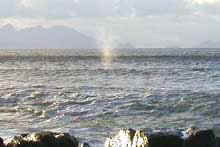
Watch the locals along Kalk Bay main road, which overlooks the little fishing harbor and the sea, and barely anyone pays attention when a southern right whale suddenly breaches in a wall of spray! Whether it's because they see them all the time, or whales just aren't a BIG DEAL, is not clear. But the result is peace and quiet when watching.
 Where to go
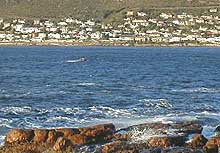
Two good spots to watch whales from the land are at Kalk Bay or Fish Hoek, in the southern suburbs of Cape Town. The suburban train runs right next to the sea from Cape Town City down to the naval dock at Simon's Town, but in recent years the security scene on the trains means it's not recommended. Instead, rent a car and take the high level road above Muizenberg (along Boyes Drive). This road clings to the steep flank of Muizenberg Mountain, and allows exceptional views across False Bay. In the waters below you, over the main road and the railway line, and just off the rocks, you may be lucky to see the dark shapes and white blow-spray of a southern right or bowhead whale. Or several.
Once you've established which way they're heading, find a road down to the shore, park, and wait for them to pass. It's a treat, it's free, and you can spend hours following pods along the coastline.
Another well-known whale-spotting area is at the town of Hermanus, about an hour and a half's drive SE of Cape Town. Overlooking the open ocean, Hermanus is a busy town that is a popular holiday escape for Cape Townians in the summer. Once again, there are several steep bluffs that allow you to get above the ocean, in order to spot the whales better. Bring binoculars, but often you won't need them.
There's no difficulty in finding out where the whales are in Hermanus. During the season, there is an official 'whale crier' who blows a horn and carries a small billboard showing where the best sightings are! Follow others to the cliff edges, then select your own spot for the best view. It beats being bounced about in a whale boat for hours, searching for those tell-tale plumes, any day!
The southern right whale, in particular, is easy to watch. Named because they are lazy swimmers, and hence were easy to harpoon from a small whaling boat, right whales were decimated by 1935, when protection was granted to the species. A slow recovery period resulted in a gradual increase in their numbers. Today, southern right whales are a pleasure to see in many places along the South African shores, where they come into the bays to calve in July - October. Seeming to favor river-fed inlets, they can be spotted in pairs or threes lolling around in the choppy seas, their stubby flukes waving gently in the air as they roll over.
Only occasionally do they seem to get frisky. Then, a short but spirited display of whale blubber provides a treat for observers, as the animals spy-hop and breach in cascades of white foam, before returning to their more sedate behavior.
Humpback whales can be seen from July - September. Unlike the southern rights, which are very tactile, humpback prefer to sing to each other from a distance, their songs being long, complex, and carrying certain refrains from one season to the next.
 Telling a southern right from a bowhead
Bowheads have exceptionally long, thin flukes, sometimes reaching a third of their entire length. Further, bowheads have characteristic black and white markings under their tails, which are visible when they dive steeply.
The southern right whale, on the other hand, is immediately identifiable by the roughened (warty) skin on their enormous heads -- known as collosities. Further, they are lazy swimmers, preferring to wallow along on the surface, their broad, flat ended flippers looking as though they have been clipped square and short.
Both species are baleen whales, having huge 'strainers' that allow them to sift through tons of water to filter out krill, copepods and other small prey.
The southern right whale was protected in 1935, the bowhead in 1966.
Swimming with jackass penguins
 Since early Greek mythology, mankind has dreamed of swimming with the dolphins. Or whales. Or whatever there is to swim with. Usually, the myth involves some sort of mammal.
Well, times change, and today you can swim with birds too. This isn't strictly a FREE item -- like many beaches around Cape Town these days, you have to pay a nominal fee (about a dollar) to go onto the beach. But once there, the penguins are free. And if you arrive in the evening (after 5:00pm), the beach is free, and the birds are at their best when they return to their nests, after feeding at sea.
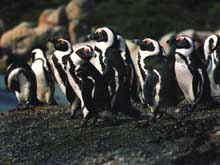
The beach in question has become famous over the past decade, when, for reasons unclear to everyone except the birds themselves, penguins moved ashore and began nesting in the nooks and crannies of Boulders Beach, just a few miles south of Simon's Town, on the Cape Peninsula. That's about an hour's drive south of Cape Town central.
The local home owners were, and still are, a bit divided about the jackass penguins' arrival. Funny and friendly, the birds' appeal quickly disappears when you get downwind of their nests. Good housekeeping is clearly not a skill passed on in jackass families. To local landowners, the penguin is not, possibly, as adorable as he is to the visiting bird watcher.
The jackass penguins appear to be wonderfully unaware of the humans sharing the inlets with them. Underwater, seen through a pair of goggles, they are a wonder to watch, weaving and 'flying' at great speeds. Boulders Beach looks as its name suggests --giant granite boulders and golden sand mini-beaches make it an ideal place to spend the day. Sheltered from the summer south-easter winds and the accompanying waves, the place is a refuge of calm and quiet on even the windiest of days.
A word of advice: leave the birds' nests alone. The holes in the ground often contain a defensive mother bird or razor-billed chick which might confuse your finger with a sardine! But once clear of their nesting area, the jackass penguin is a pretty laid-back kind of bird. He doesn't mind, if you don't mind. Bring a camera, and enjoy an amazing experience of Nature.
About Jackass penguins
Jackass penguins are really African Penguins (Sphenicus demersis), but are known as "jackass" because of their braying call, which closely resembles that of a donkey. Decimated by loss of nesting habitat, reduced food stocks, and people stealing their eggs, they have come back from a low in the 1950s, and are now found along much of the southern coast of South Africa. One of the smallest of the penguin family, the males weight about 3.5kg, the females about 3.1kg. Breeding occurs throughout the year, when the female lays one or two eggs.
In 1980 they first came ashore at Boulders Beach, and have been coming ashore ever since, in increasing numbers, where they nest in the bushes above the beach, and appear to ignore the local residential houses (with their dogs and cats) and the weekend swimmers.
A local hero, in the form of an old man known affectionately as "Van" (Mr H.J.van der Merwe), has been caring for the birds since 1982. He can be reached at van@bouldersbeach.co.za Apart from tidying up around the place to reduce human and penguin conflicts, he has brokered peace between the birds and the local residential tax payers, and generally smoothed the penguins' path back into the region. Perhaps his greatest contribution has been cleaning up oil streaks, that have affected the birds.
There are 17 species of penguin, and all are found in the southern hemisphere. Is it a coincidence that polar bears are only found in the northern?
Getting there.
From New York or Miami, South African Airways, Delta and Northwest fly direct to Cape Town. Or go via Europe using any of the trans-Atlantic carriers to London or Amsterdam or Frankfurt, and then fly British Airways, South African Airways, Lufthansa or KLM to Cape Town
Ten popular places every visitor should see in Cape Town.
- The Table Mountain Aerial Cableway- the view from the top is spectacular in every direction. http://blue.lizard.co.za/mountain
- The Victoria & Alfred Dock development - especially the Two Oceans Aquarium. http://www.waterfront.co.za and http://www.aquacape.co.za
- Sandy Bay Beach - for heavenly bodies (nude)
- Chapman's Peak Drive - a road cut from cliffs hanging above the sea.
- The Cape Castle - built by the Dutch in the 1600s, and still used today.
- The Cape Wine Lands - tour the wineries of Stellenbosch and Paarl. http://www.winelands.co.za
- Clifton Beach - for heavenly bodies (clothed, but only somewhat).
- Kirstenbosch Botanical Gardens - one of the great gardens of the world. www.nbi.ac.za/gardens_kirstenbosch.htm
- Cape Point Nature Reserve - baboons, buck, and the meeting point of two oceans. http://www.capepoint.co.za
- Boulders Beach - where you can swim with jackass penguins. www.southafrica.net/news/penguins.html
Contact your local South Africa Tourist Board. In North America call toll free on 800 822 5368 .
Humpback whales can be seen from July - September. Unlike the southern rights, which are very tactile, humpback prefer to sing to each other from a distance, their songs being long, complex, and carrying certain refrains from one season to the next. Telling a southern right from a bowhead
Bowheads have exceptionally long, thin flukes, sometimes reaching a third of their entire length. Further, bowheads have characteristic black and white markings under their tails, which are visible when they dive steeply.
The southern right whale, on the other hand, is immediately identifiable by the roughened (warty) skin on their enormous heads -- known as collosities. Further, they are lazy swimmers, preferring to wallow along on the surface, their broad, flat ended flippers looking as though they have been clipped square and short.
Both species are baleen whales, having huge 'strainers' that allow them to sift through tons of water to filter out krill, copepods and other small prey.
The southern right whale was protected in 1935, the bowhead in 1966.
Swimming with jackass penguins
 Since early Greek mythology, mankind has dreamed of
swimming with the dolphins. Or whales. Or whatever there is to swim with. Usually, the
myth involves some sort of mammal.
Since early Greek mythology, mankind has dreamed of
swimming with the dolphins. Or whales. Or whatever there is to swim with. Usually, the
myth involves some sort of mammal.
Well, times change, and today you can swim with birds too. This isn't strictly a FREE item -- like many beaches around Cape Town these days, you have to pay a nominal fee (about a dollar) to go onto the beach. But once there, the penguins are free. And if you arrive in the evening (after 5:00pm), the beach is free, and the birds are at their best when they return to their nests, after feeding at sea.
The beach in question has become famous over the past decade, when, for reasons unclear to everyone except the birds themselves, penguins moved ashore and began nesting in the nooks and crannies of Boulders Beach, just a few miles south of Simon's Town, on the Cape Peninsula. That's about an hour's drive south of Cape Town central.
The local home owners were, and still are, a bit divided about the jackass penguins' arrival. Funny and friendly, the birds' appeal quickly disappears when you get downwind of their nests. Good housekeeping is clearly not a skill passed on in jackass families. To local landowners, the penguin is not, possibly, as adorable as he is to the visiting bird watcher.
The jackass penguins appear to be wonderfully unaware of the humans sharing the inlets with them. Underwater, seen through a pair of goggles, they are a wonder to watch, weaving and 'flying' at great speeds. Boulders Beach looks as its name suggests --giant granite boulders and golden sand mini-beaches make it an ideal place to spend the day. Sheltered from the summer south-easter winds and the accompanying waves, the place is a refuge of calm and quiet on even the windiest of days.
A word of advice: leave the birds' nests alone. The holes in the ground often contain a defensive mother bird or razor-billed chick which might confuse your finger with a sardine! But once clear of their nesting area, the jackass penguin is a pretty laid-back kind of bird. He doesn't mind, if you don't mind. Bring a camera, and enjoy an amazing experience of Nature.
About Jackass penguins
Jackass penguins are really African Penguins (Sphenicus demersis), but are known as "jackass" because of their braying call, which closely resembles that of a donkey. Decimated by loss of nesting habitat, reduced food stocks, and people stealing their eggs, they have come back from a low in the 1950s, and are now found along much of the southern coast of South Africa. One of the smallest of the penguin family, the males weight about 3.5kg, the females about 3.1kg. Breeding occurs throughout the year, when the female lays one or two eggs.
In 1980 they first came ashore at Boulders Beach, and have been coming ashore ever since, in increasing numbers, where they nest in the bushes above the beach, and appear to ignore the local residential houses (with their dogs and cats) and the weekend swimmers.
A local hero, in the form of an old man known affectionately as "Van" (Mr H.J.van der Merwe), has been caring for the birds since 1982. He can be reached at van@bouldersbeach.co.za Apart from tidying up around the place to reduce human and penguin conflicts, he has brokered peace between the birds and the local residential tax payers, and generally smoothed the penguins' path back into the region. Perhaps his greatest contribution has been cleaning up oil streaks, that have affected the birds.
There are 17 species of penguin, and all are found in the southern hemisphere. Is it a coincidence that polar bears are only found in the northern?
Getting there.
From New York or Miami, South African Airways, Delta and Northwest fly direct to Cape Town. Or go via Europe using any of the trans-Atlantic carriers to London or Amsterdam or Frankfurt, and then fly British Airways, South African Airways, Lufthansa or KLM to Cape Town
Ten popular places every visitor should see in Cape Town.
- The Table Mountain Aerial Cableway- the view from the top is spectacular in every
direction. http://blue.lizard.co.za/mountain
- The Victoria & Alfred Dock development - especially the Two Oceans Aquarium. http://www.waterfront.co.za and http://www.aquacape.co.za
- Sandy Bay Beach - for heavenly bodies (nude)
- Chapman's Peak Drive - a road cut from cliffs hanging above the sea.
- The Cape Castle - built by the Dutch in the 1600s, and still used today.
- The Cape Wine Lands - tour the wineries of Stellenbosch and Paarl. http://www.winelands.co.za
- Clifton Beach - for heavenly bodies (clothed, but only somewhat).
- Kirstenbosch Botanical Gardens - one of the great gardens of the world. www.nbi.ac.za/gardens_kirstenbosch.htm
- Cape Point Nature Reserve - baboons, buck, and the meeting point of two oceans. http://www.capepoint.co.za
- Boulders Beach - where you can swim with jackass penguins. www.southafrica.net/news/penguins.html
Contact your local South Africa Tourist Board. In North America call toll free on 800 822 5368 .