
 Famous Faces, Famous Places and Famous Foods


The Hounds of the Boulevards
As I write this, our blond dog is sitting on the floor next to me in our Minneapolis apartment. This article is about the dogs of Paris, but to place them in perspective, let me tell you about ours. I just got back from walking him in the park. Two ladies were promenading, and he trotted up to them wagging his tail. They petted him. "He's so cute," they cooed. "He should be in TV commercials." They would never have said that had there been another dog around. I'll explain.
He is between medium and small and of undetermined breed. The woman who gave him to us as a puppy said that a male African Basenji was lurking near her Schnauzer at the time the litter was conceived. When she hit him with a broom, she swears the Basenji grinned at her.
We named our puppy Hachiko. Roughly translated from Japanese, it means honey child and at the time we got him, it described him perfectly. He is also the namesake of a famous dog, who has a bronze memorial in Tokyo’s Shibuya subway station. We passed by it often when we lived in Japan.
It is said that this Hachiko would go to the station with his master in the morning, wait there all day until his master returned and then trot home beside him. One day, the master did not come back. He had died. The dog waited. He never left the station, never went home. He became a mascot, a symbol of patience and loyalty. Commuters gave him food and water until he died years later. During the war years, when all metal was being melted down for arms, the people would not allow the statue to be destroyed.
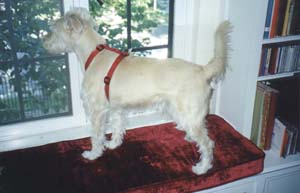 We left a residence of many
acres, where our Hachiko had little contact with other dogs and was lonely. Now that we
have moved to the city, he sees loads of fellow canines and has a new lease on life. When
he is inside, he defends our second-floor apartment, mostly by howling at canine passersby
from our burgundy window seat cushions. But he aches to be outside.
We left a residence of many
acres, where our Hachiko had little contact with other dogs and was lonely. Now that we
have moved to the city, he sees loads of fellow canines and has a new lease on life. When
he is inside, he defends our second-floor apartment, mostly by howling at canine passersby
from our burgundy window seat cushions. But he aches to be outside.
In our old surroundings, a leash was not required. In anticipation of city living, we got
Hachiko a red one with harness to match. On a walk, he sniffs and anoints every lamppost,
tree trunk, and fireplug. But he comes unglued when he sees another dog on a leash or
– heaven forbid – running free. He experiences a territorial identity crisis of
colossal proportions. Formerly, everything was his. He thinks it still is – and
claims it. Remember, he is not a large dog, but he becomes the incredible hulk, a raging
bull, the hound from hell. His chest expands, his vigor soars, and he nearly bursts the
harness. He bolts forward, whatever the size of his foe, berating the intruder for
treading on his soil.
As I labored to restrain him one day, a passing gentleman observed, "You could water
ski behind that dog!" A lithe young thing on inline skates slid by and smirked under
her breath, "Who's walking who?"
"I'm walking him!" I shouted. But it was a lie.
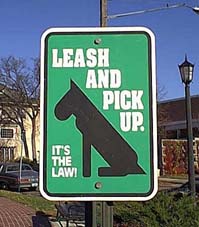
Living in a big city, we are forced to deal with another challenge. Signs in the neighborhood mandate "Leash and pick up. It's the law!" Everyone picks up.
 I have mastered the behind-the-back leash pass, the
underarm clutch to free both hands, the outside-to-in plastic bag retrieval. And I pray
for bags without holes.
I have mastered the behind-the-back leash pass, the
underarm clutch to free both hands, the outside-to-in plastic bag retrieval. And I pray
for bags without holes.
Now on to the canines of Paris. My wife and I were in the City of Light recently and one
thing was apparent: Parisians love their dogs. Large, small, minute – dogs are
everywhere – in department stores, restaurants, elevators, trains. In the Bon
Marché,
there is a spot where you can tie the leash over a bar and park your dog.
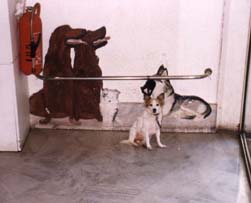
Parisian dogs are beautifully behaved, never an altercation between them. Hardly the description of our pooch’s behavior. .
But in Paris, something else is apparent. Pick up is not part of the program. No such law.
Decidedly not. It's watch your step and proceed with caution.
One morning, we exited our building and started down the sidewalk. A young man in suit and
tie bolted through the door of the next building and stopped in his tracks – one foot
poised precariously over something not picked up. He smiled sheepishly and hurried off
unscathed. Others are not so lucky. We saw a gentleman step in something and skate down
the avenue trying to get it off. Telltale streaks are everywhere. But not for long. The
city takes care of it.
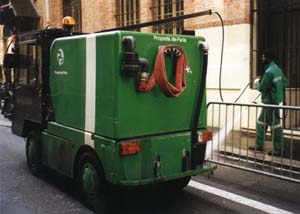
Crews with water spewing machines launder the sidewalks daily.
 Moving from the ridiculous to the sublime, being conscientious tourists, we made a
pilgrimage to the Louvre. Artworks there confirm that humans' love affair with dogs is
nothing new. Dogs abound in ancient art. Dogs belonging to kings were doubtless buried
with their masters. In stone burial sculptures, dogs were often carved at the feet of
monarchs.
Moving from the ridiculous to the sublime, being conscientious tourists, we made a
pilgrimage to the Louvre. Artworks there confirm that humans' love affair with dogs is
nothing new. Dogs abound in ancient art. Dogs belonging to kings were doubtless buried
with their masters. In stone burial sculptures, dogs were often carved at the feet of
monarchs.
Tapestries covering immense walls portray the prominence of dogs in people’s lives.
But in one memorable rendering, a contented-looking pup is at the forefront of an outdoor
scene in the tail-up, squatting position. Everything is depicted in colorful detail,
including that which was not picked up. It hangs for posterity in one of the most famous
museums in the world.
Curious, isn't it, that the artist chose to record this subject? I wonder. Was it his
conscious choice to depict everything about nature? Or was it a prank, a touch of bathroom
humor? Hmm. I sense the latter.
Can you imagine a lackey in those days poised (as we are), sack in hand, to pick up when
the job was done? Nope. No more than in modern Paris. Parisians are practical. They are
realists. They call a spade a spade.
Does it detract from the City of Light, diminish its ambiance? Not one iota. It's natural.
It's Paris. It's French. You just watch your step.
For information on visiting Paris, contact the Paris Tourist office Tel: 33 8 36 68
31 12 Fax: 33 1 49 52 53 00, or visit their Website at: www.paris-touristoffice.com .
Copyright © 2000 by James D. Priest