
 Famous Faces, Famous Places and Famous Foods


Undiscovered Cape Town
Stakes keep rising in ecotourism one-upmanship
No one in his right mind would go to all the trouble of flying to the tip of Africa, and then waste his time looking at flowers, right? Wrong! Really, really wrong.
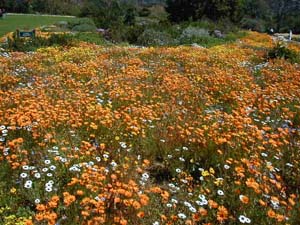 The area within 200 miles of Cape Town is host to one of the rarest, and most spectacular flower displays in the world.
Consider this: as Joni Mitchell told us in the '60s, we're paving paradise and putting up parking lots – as fast as we can. Hence the growth in ecotourism over the past decade. Okay, hands up those who could even spell ecotourism a decade ago? No one. Right.
Since much of this ecotourism stuff is still pretty new, the players are new too, and there is an insidious undercurrent that some of you might not have picked up on. If we're going back to Nature, and turning away from all that crass commercially tourist stuff, then, baby, we're gonna go back to Nature with more vengeance than anyone else. That means experiencing more Nature, seeing more Nature, and taking more Nature photos.
Pathetic, isn't it? But there you are, we're a competitive species. And talking of species, that's one of the key issues here. Have you noticed how 10 years ago it was okay to go to Serengeti National Park and see 20 different mammal species? No more. Now, you have to see 50, and half of them endangered, or you’ll get no respect from the cadres of eco-tourists. Nobody at your next dinner party will be impressed if you mention you saw wildebeest (OK, make that thousands of wildebeest, but still, basically, just wildebeest) and zebras. These days, you have to get up close and personal with something really rare, like mountain gorillas, oribis, Demi Moore, or some similarly rare species. Difficult to do.
In the mid-1990s, there was a subtle shift in ecotourism to compensate for this phenomenon. It was called birding. Suddenly, you could see 200 species, not just 20. More was better. And no one was going to quibble when you talked about the red-collared barbet, the greater spoonbill, or the European bee-eater.
But even this level of nature appreciation is waning. Now there are people who have evolved to such a competitive level, they don't actually have to see the bird any more; they identify it simply by listening. That's a bit unfair, don't you think? I mean, would you take someone seriously if they told you solemnly they had heard London's Big Ben, but hadn't actually bothered to get off the bus and look at it? No, I wouldn't either.
Eco-tourists are a competitive lot, but they're easy to recognize. They carry those dinky little fold-up binoculars that cost a bomb, a Leatherman that sets off every airport security device, and they produce little check sheets to tick off the species as they spot them. The really serious ones have an Eddie Bauer pack with a massive foldout tripod and giant spotting scope.
The new millennium craze
If you've already got all that gear, and are looking for new challenges, I'm happy to announce there is now a third level of enlightenment, beyond mammal and bird spotting. It's plant-spotting. And in this regard, you won't find a better place for fantastic fauna, than in the region around Cape Town (see sidebar). The area is world-class. Where you might only see 20 mammals on a holiday before, or 200 bird species, the serious nature fiend can now record 2,000 plants.
Roughly stated, there are six floral kingdoms in the world today.
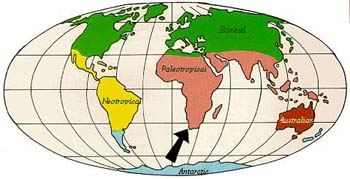
One, the Boreal Forest Kingdom, extends across the 20 million square miles of Russia, Europe and North America, making up 40 percent of the (dry) Earth's surface.
At the other end of the spectrum (so to speak), is the Cape Floral Kingdom, occupying a mere 0.04 percent of that surface. Yet, inside that tiny area, barely 500 miles long and 200 miles wide, the aspiring ecotourist will find a staggering 8,600 plants, of which 5,800 are unique to the area. This is the home of watsonia, ixia, gladiolus, erica, protea … plants that are now so common around the world and found in so many gardens, hardly anyone even wonders where they came from originally. They came from the Cape. And they can be found in a bewildering variety of species. There are over 100 pelargoniums (that's geraniums to you), over 500 of the world's 740 ericas species. The list is extensive. Even if you never graduated beyond lawn-school, you cannot help being impressed by the diversity. Charles Darwin would have had a ball.
The Serengeti of flowers
Before we discuss where to go, let's cover when. Since the South Africans, like the Australians, live on their heads (or something), their summer is our winter, and vice versa. The rains fall in winter, which means the best flower-watching is in their spring, August and September, after those winter rains.
If you can't make it then, or you live in a northern climate and want to get away in winter, just remember it's their summer out there and can be a sizzling 100 degrees Fahrenheit. On the good side, however, there are lots of different flowers all year round.
The main reason for going in September is to see the spring flowers in Namaqualand. This is an area that extends 200 miles to 500 miles north of Cape Town. The road north (the N7) is paved and fine to travel at 70 miles an hour. The flowers, however, are erratic. One year they will be good, the next year spectacular, the following year only OK. It depends on the rains, and they vary.
The National Botanical Gardens at Kirstenbosch
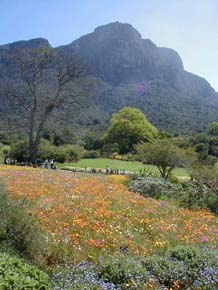 If you aren't inclined to drive a full day to see the carpets of spectacular daisies, then visit the National Botanical Gardens at Kirstenbosch (www.nbi.ac.za/gardens_kirstenbosch.htm), on the slopes of Table Mountain. Located almost in the heart of the suburbs, Kirstenbosch is a multi-acre garden with wide walks, specialized plant areas, greenhouses, long established trees, and a huge diversity of flora, as befits a botanical garden located in such a unique region. Plan to spend some time there. On summer evenings (December to January) there are concerts. During much of the rest of the year, there are special flower shows to showcase the species then in bloom. The recently completed Silver Tree Restaurant features a café-style area and a sit-down, white linen cloth area with a very eclectic menu. You can order warthog, crocodile tail, cape buffalo steaks, and numerous other unusual dishes.
Located in the gardens, huge soapstone carvings (often weighing several tons) from neighboring Zimbabwe, add a gallery-like feel to the already manicured layout of lawn, path and beds. But the best thing about Kirstenbosch is the way everything is explained. Practically every plant, shrub, bush or tree carries a label that describes the species, gives the common name and additional information. You can emerge from the gardens feeling smug about improving your knowledge. And isn't that the purpose of eco-toursm?
Outside the city ... wildflower shows
Numerous small towns have, over the years, developed flower shows that are well attended by locals and tourist alike. One of the oldest and best, is the Darling Flower Show. Well, a name like that is tough to beat. Actually, there really is a town called Darling, about an hour north of Cape Town, and every mid-September they host a not-to-be-missed floral show over a long weekend.
Visit the orchid show first. The Darling area is home to numerous indigenous orchids and disas, and the organizers bring together a wide range of local and exotic plants for the visitor to admire.
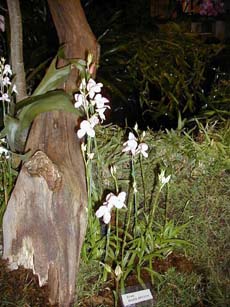 Once through the exhibition area, you pass into a warehouse where you can buy many of the plants you have just seen, in all sizes from seeds, bulbs and cuttings through to huge established plants.
Darling, with a population around 3,000, is not a large town, but the local folks are proud of their show. Let's leave the orchids, and head across to the main event, the wildflower show. Year after year, collectors have learned where the best of the best in fynbos is, and each year they create museum-like dioramas of plants, collected together in themes. There will be a dry karoo-like area section, filled with succulents, daisies (in flower), ixias, renoster bush and more. The next showpiece might be a wetland diorama, filled with arum lilies, marsh grasses, anemones, leucadendrons and such.
The marvel of these displays is not simply that they are on display in full bloom, but that they look like they have grown there.
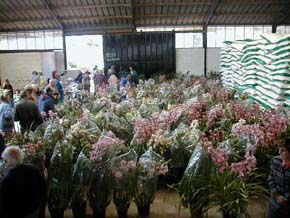 Wildflowers are notoriously difficult to cultivate or store. The show somehow manages to bring together and display swathes of spectacular spring flowers. Many of the plants are labeled, but there is a section at the end of the building where individual plants (usually cut, and in vases) are fully described with Latin and local names.
The volunteers are friendly, and keen to chat. Mr. Duckett is a local, retired farmer who has been helping at the Flower Show for longer than he can remember. Every year he has a few specialties that he knows where to find. He digs them up and brings them to the show in a frantic rush before they’ve begun to wilt. Many others do the same. Together, the whole creation appears in just a few hours of hectic work.
We talk to the local plant lovers about watsonias, which resemble gladiolus plants, but have a more delicate flower, and I mention that at Kirtsenbosch earlier that week I saw an entire bed of white ones, which must be a new variety. I have, by accident, pushed the right button on Mr. Duckett.
"I'm glad you mentioned that, because I'm the fellow who found that flower. One year ... I forget how many years ago that was now … I was collecting for the flower show, and there, in the whole field of wild watsonias, there was one white stem. Just one. I didn't have time then, but later I came back and dug it up. Carefully, of course. And I sent it down to the people at Kirstenbosch. And they did whatever they do, and now there's hundreds … thousands ... it's wonderful."
Mr. Duckett is clearly pleased with his tiny contribution to the field of horticulture. And, no, the variety isn't named after him. It's named after the area. "I just found it," he says modestly.
An hour's drive north of Darling is the town of Clanwilliam (www.places.co.za/html/clanwilliam.html), which hosts a similar flower show in late August. Closer to Namaqualand and the Northern Cape Province, the flowers reflect the drier and more rugged annuals of the region. From the town, the rugged sandstone crags of the Cedarberg Range (www.places.co.za/html/cederbergwa.html) are visible. A great area for hiking and rock climbing, and, of course, flora spotting. But beware of the December to February season, when the heat rises to over 100 degrees Fahrenheit in the shade.
Next month I will introduce you to the ancient world of the bushman.
Getting there:
From New York or Miami, South African Airways, Delta and Northwest fly direct to Cape Town. Or route via Europe using any of the trans-Atlantic carriers to London, Amsterdam or Frankfurt, and then use British Airways, South African Airways, Lufthanza or KLM to Cape Town.
Fynbos, and the Cape Floral Kingdom
If you want to impress the locals, you'll have to learn how to say it properly. Fynbos is a Dutch word, and means 'fine bush' in English. It's pronounced "fain-boss," and it's the word used to describe collectively the finely structured plants that make up the 8,600 different species of the greater Cape Town region. To put that diversity in perspective, there are only three times more species in the whole of the rest of Africa combined.
Since first colonized by the Dutch in 1660, there has been keen interest in the area's plants. It's bulbs and seeds have been gathered and distributed across the great houses of Europe for huge sums of money. Since the last glacial cooling (not actually an Ice Age) of 12,000 years ago, the area has been home to 526 of the world's 740 erica species; 96 of the world's 160 gladioli; 69 of the world's 112 proteas.
Surviving in a region that has poor rainfall (10 to 30 inches annually), there are over 1,400 bulb species alone. Seldom taller than a person, fynbos plants are usually characterized by their small aromatic leaves and delicate, brightly colored flowers.
Fire plays an important part of fynbos regeneration. With the advent of western man 300 years ago, some regions avoided being burnt for extended periods. The result has been a steady deterioration of diversity. A fire every 10 to 20 years seems to be the most effective method of stimulating re-growth. Indeed, many plants rely on fire to trigger their seeds, before they will grow.
Roughly stated, there are six floral kingdoms in the world today.

One, the Boreal Forest Kingdom, extends across the 20 million square miles of Russia, Europe and North America, making up 40 percent of the (dry) Earth's surface.
At the other end of the spectrum (so to speak), is the Cape Floral Kingdom, occupying a mere 0.04 percent of that surface. Yet, inside that tiny area, barely 500 miles long and 200 miles wide, the aspiring ecotourist will find a staggering 8,600 plants, of which 5,800 are unique to the area. This is the home of watsonia, ixia, gladiolus, erica, protea … plants that are now so common around the world and found in so many gardens, hardly anyone even wonders where they came from originally. They came from the Cape. And they can be found in a bewildering variety of species. There are over 100 pelargoniums (that's geraniums to you), over 500 of the world's 740 ericas species. The list is extensive. Even if you never graduated beyond lawn-school, you cannot help being impressed by the diversity. Charles Darwin would have had a ball.
The Serengeti of flowers
Before we discuss where to go, let's cover when. Since the South Africans, like the Australians, live on their heads (or something), their summer is our winter, and vice versa. The rains fall in winter, which means the best flower-watching is in their spring, August and September, after those winter rains.
If you can't make it then, or you live in a northern climate and want to get away in winter, just remember it's their summer out there and can be a sizzling 100 degrees Fahrenheit. On the good side, however, there are lots of different flowers all year round.
The main reason for going in September is to see the spring flowers in Namaqualand. This is an area that extends 200 miles to 500 miles north of Cape Town. The road north (the N7) is paved and fine to travel at 70 miles an hour. The flowers, however, are erratic. One year they will be good, the next year spectacular, the following year only OK. It depends on the rains, and they vary.
The National Botanical Gardens at Kirstenbosch
 If you aren't inclined to
drive a full day to see the carpets of spectacular daisies, then visit the National
Botanical Gardens at Kirstenbosch (www.nbi.ac.za/gardens_kirstenbosch.htm),
on the slopes of Table Mountain. Located almost in the heart of the suburbs, Kirstenbosch
is a multi-acre garden with wide walks, specialized plant areas, greenhouses, long
established trees, and a huge diversity of flora, as befits a botanical garden located in
such a unique region. Plan to spend some time there. On summer evenings (December to
January) there are concerts. During much of the rest of the year, there are special flower
shows to showcase the species then in bloom. The recently completed Silver Tree Restaurant
features a café-style area and a sit-down, white linen cloth area with a very eclectic
menu. You can order warthog, crocodile tail, cape buffalo steaks, and numerous other
unusual dishes.
If you aren't inclined to
drive a full day to see the carpets of spectacular daisies, then visit the National
Botanical Gardens at Kirstenbosch (www.nbi.ac.za/gardens_kirstenbosch.htm),
on the slopes of Table Mountain. Located almost in the heart of the suburbs, Kirstenbosch
is a multi-acre garden with wide walks, specialized plant areas, greenhouses, long
established trees, and a huge diversity of flora, as befits a botanical garden located in
such a unique region. Plan to spend some time there. On summer evenings (December to
January) there are concerts. During much of the rest of the year, there are special flower
shows to showcase the species then in bloom. The recently completed Silver Tree Restaurant
features a café-style area and a sit-down, white linen cloth area with a very eclectic
menu. You can order warthog, crocodile tail, cape buffalo steaks, and numerous other
unusual dishes.
Located in the gardens, huge soapstone carvings (often weighing several tons) from neighboring Zimbabwe, add a gallery-like feel to the already manicured layout of lawn, path and beds. But the best thing about Kirstenbosch is the way everything is explained. Practically every plant, shrub, bush or tree carries a label that describes the species, gives the common name and additional information. You can emerge from the gardens feeling smug about improving your knowledge. And isn't that the purpose of eco-toursm?
Outside the city ... wildflower shows
Numerous small towns have, over the years, developed flower shows that are well attended by locals and tourist alike. One of the oldest and best, is the Darling Flower Show. Well, a name like that is tough to beat. Actually, there really is a town called Darling, about an hour north of Cape Town, and every mid-September they host a not-to-be-missed floral show over a long weekend.
Visit the orchid show first. The Darling area is home to numerous indigenous orchids and disas, and the organizers bring together a wide range of local and exotic plants for the visitor to admire.
 Once through the exhibition area, you pass into a
warehouse where you can buy many of the plants you have just seen, in all sizes from
seeds, bulbs and cuttings through to huge established plants.
Once through the exhibition area, you pass into a
warehouse where you can buy many of the plants you have just seen, in all sizes from
seeds, bulbs and cuttings through to huge established plants.
Darling, with a population around 3,000, is not a large town, but the local folks are proud of their show. Let's leave the orchids, and head across to the main event, the wildflower show. Year after year, collectors have learned where the best of the best in fynbos is, and each year they create museum-like dioramas of plants, collected together in themes. There will be a dry karoo-like area section, filled with succulents, daisies (in flower), ixias, renoster bush and more. The next showpiece might be a wetland diorama, filled with arum lilies, marsh grasses, anemones, leucadendrons and such.
The marvel of these displays is not simply that they are on display in full bloom, but that they look like they have grown there.
 Wildflowers are notoriously
difficult to cultivate or store. The show somehow manages to bring together and display
swathes of spectacular spring flowers. Many of the plants are labeled, but there is a
section at the end of the building where individual plants (usually cut, and in vases) are
fully described with Latin and local names.
Wildflowers are notoriously
difficult to cultivate or store. The show somehow manages to bring together and display
swathes of spectacular spring flowers. Many of the plants are labeled, but there is a
section at the end of the building where individual plants (usually cut, and in vases) are
fully described with Latin and local names.
The volunteers are friendly, and keen to chat. Mr. Duckett is a local, retired farmer who has been helping at the Flower Show for longer than he can remember. Every year he has a few specialties that he knows where to find. He digs them up and brings them to the show in a frantic rush before they’ve begun to wilt. Many others do the same. Together, the whole creation appears in just a few hours of hectic work.
We talk to the local plant lovers about watsonias, which resemble gladiolus plants, but have a more delicate flower, and I mention that at Kirtsenbosch earlier that week I saw an entire bed of white ones, which must be a new variety. I have, by accident, pushed the right button on Mr. Duckett.
"I'm glad you mentioned that, because I'm the fellow who found that flower. One year ... I forget how many years ago that was now … I was collecting for the flower show, and there, in the whole field of wild watsonias, there was one white stem. Just one. I didn't have time then, but later I came back and dug it up. Carefully, of course. And I sent it down to the people at Kirstenbosch. And they did whatever they do, and now there's hundreds … thousands ... it's wonderful."
Mr. Duckett is clearly pleased with his tiny contribution to the field of horticulture. And, no, the variety isn't named after him. It's named after the area. "I just found it," he says modestly.
An hour's drive north of Darling is the town of Clanwilliam (www.places.co.za/html/clanwilliam.html), which hosts a similar flower show in late August. Closer to Namaqualand and the Northern Cape Province, the flowers reflect the drier and more rugged annuals of the region. From the town, the rugged sandstone crags of the Cedarberg Range (www.places.co.za/html/cederbergwa.html) are visible. A great area for hiking and rock climbing, and, of course, flora spotting. But beware of the December to February season, when the heat rises to over 100 degrees Fahrenheit in the shade.
Next month I will introduce you to the ancient world of the bushman.
Getting there:
From New York or Miami, South African Airways, Delta and Northwest fly direct to Cape Town. Or route via Europe using any of the trans-Atlantic carriers to London, Amsterdam or Frankfurt, and then use British Airways, South African Airways, Lufthanza or KLM to Cape Town.
Fynbos, and the Cape Floral Kingdom
If you want to impress the locals, you'll have to learn how to say it properly. Fynbos is a Dutch word, and means 'fine bush' in English. It's pronounced "fain-boss," and it's the word used to describe collectively the finely structured plants that make up the 8,600 different species of the greater Cape Town region. To put that diversity in perspective, there are only three times more species in the whole of the rest of Africa combined.
Since first colonized by the Dutch in 1660, there has been keen interest in the area's plants. It's bulbs and seeds have been gathered and distributed across the great houses of Europe for huge sums of money. Since the last glacial cooling (not actually an Ice Age) of 12,000 years ago, the area has been home to 526 of the world's 740 erica species; 96 of the world's 160 gladioli; 69 of the world's 112 proteas.
Surviving in a region that has poor rainfall (10 to 30 inches annually), there are over 1,400 bulb species alone. Seldom taller than a person, fynbos plants are usually characterized by their small aromatic leaves and delicate, brightly colored flowers.
Fire plays an important part of fynbos regeneration. With the advent of western man 300 years ago, some regions avoided being burnt for extended periods. The result has been a steady deterioration of diversity. A fire every 10 to 20 years seems to be the most effective method of stimulating re-growth. Indeed, many plants rely on fire to trigger their seeds, before they will grow.