
 Famous Faces, Famous Places and Famous Foods

Undiscovered Cape Town, Part 2
Anyone who saw Jamie Uys' classic movie, The Gods Must be Crazy, knows what a bushman looks like. Small, wrinkled, and tough, these ancient people were perfectly adapted to their environment, living a nomadic life in small groups of 10 to 20, hunting and gathering as they went. Today, almost nothing remains of them or their culture. Hunted, poisoned, and plagued by disease, they disappeared from the Cape centuries ago. Only a very few clans exist in the remotest reaches of Namibia and Botswana, which is where, no doubt, film director Uys found his talented movie star.
But although these little people, who spoke in a series of over 150 different clicks, and called themselves the 'San, may have gone, they left behind an amazing collection of paintings on rocks and caves, that give us just a tiny glimpse into their world of 500 to 2,500 years ago.
There are a lot of paintings in the western Cape, but many have been vandalized. In the Bushman's Kloof Wilderness Reserve, however, the remoteness of the area and the dryness of the climate have combined to provide a feast of rare and interesting primitive art.
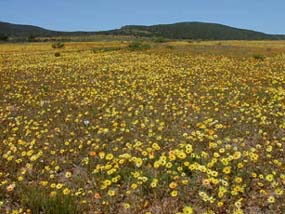 Located not far from Clanwilliam, a newly developed retreat offers first-class accommodation, great food, miles and miles of fynbos, and guided interpretive tours of the bushman paintings. Drive the gravel Pakhuis Pass, under great walls of orange sandstone, past the grave of celebrated poet Dr. Louis Leipoldt, past plantations of rooibos tea, into the rain shadow area of Bushman's Kloof (rapidttp.com/tourism/98/98sepp.html).
There are over 120 rock art sites, and as an added bonus, the wildflowers in August and September are spectacular. A typical day starts at 7:30 with "pre-breakfast," which is really quite a serious breakfast. At 8 o'clock, visitors board open Land Rovers and drive out to the view the paintings.
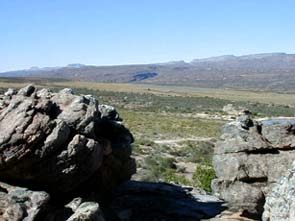 On the way they stop to admire the variety of buck and antelope that have been stocked on what was six old farms, and is now a 15,000-acre reserve, bordering on the Cedarberg Mountain Reserve.
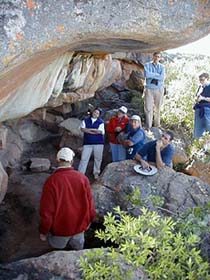
Nearly all the caves involve some walking. Some are a few yards from the road, others may take half an hour to reach. Once there, the ranger explains the history of the 'San people, how the paintings were made (hematite for the red, limnite for the white), and what they might mean. The white dyes have now faded completely, except for under ultra-violet light. Here, there is fertile ground for interpretation. Some argue the drawings reflect reality, and are simply historical records of hunts and other events. But there are anomalies there. On the wall, male hunters (you can tell they're male, all right) are in pursuit of an elephant, which has numerous arrows stuck in it.
 Well, elephants did occupy the area many centuries ago, but there was no way that a Bushman, with a two- foot bow, a 15-inch arrow, and a low toxicity poison, could have been crazy enough to tackle an elephant.
Are these depictions of dreams, then? We may never know. The sources have gone, and we are left with just a few, strangely simple, strangely elegant, drawings. It has been suggested that the paintings reflect the Bushman's search for spirituality.
Look, a large figure represents the shaman … he is mind traveling … long jets from his head represent streams of blood from a hemorrhage, or power flows out of his shoulders … he is hunting the elephant or eland in his mind ... or drawing power from these large animals.
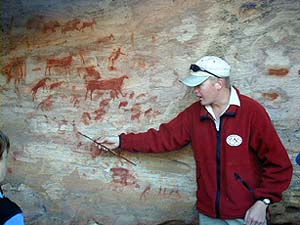 We don't know. What we do know is that the Bushmen's diet was 70 percent vegetarian (roots, bulbs) and only 30 percent meat (small animals like rock rabbits, porcupines, hares). Curiously, there are no paintings of rock rabbits or hares. Why this is, we don't know. But as we stand under the overhang of a sandstone bluff, the curious red paintings scattered randomly across the cream colored walls, and look out across a landscape that hasn't changed since the last 'San left 200 years ago, we get a strange feeling of separation and yet togetherness, that has plagued this region for so long.
Back at the lodge for brunch at 11:30, we are left to amuse ourselves for the afternoon, either swimming in the river pools, or riding mountain bikes along the rugged back roads of the reserve. At 4 p.m. there is the British-style tea with huge amounts of food (cakes, cookies, cheesies, appetizers) and drinks (juice, coffee, and yes, even tea). By 4:30 we leave on another guided tour, this time of the wildlife. We see springbuck, blesbuck and the very rare Cape Mountain zebra. The zebra are an interesting tale of conservation. Reduced to just 91 animals in the 1950s, careful protection has allowed the species to totter back to 1,200 animals today, of which some 80 may be seen at Bushman's Kloof (www.2-calls.co.za/ClanW.html). They are still regarded as the mammal closest to extinction in southern Africa.
The sun sinks towards the Cedarberg Range to the west. At dusk, the Land Rover stops at a suitable high point and the guests wander around, drink sundowners of choice, and nibble on snacks. Blankets are produced as dusk falls quickly in Africa, and we return in the dark. The ranger/driver uses a powerful searchlight to catch the reflections of pairs of eyes in the surrounding bush. Back at the lodge by 8 p.m., we have time to wash before drinks in the bar and then the second "proper" meal of the day (in actual fact, the fifth of the day) … dinner.
When you go:
Flights: From New York or Miami, South African Airways, Delta and Northwest fly direct to Cape Town. Or route via Europe using any of the trans-Atlantic carriers to London, Amsterdam or Frankfurt, and then use British Airways, South African Airways, Lufthanza or KLM to Cape Town.
For more information on South Africa, visit the official Travel and Tourism Website at southafrica.net/, Tel: 1 800 822-5368.
For more information on Cape Town, visit www.capetownonline.co.za/.
 Well, elephants did occupy
the area many centuries ago, but there was no way that a Bushman, with a two- foot bow, a
15-inch arrow, and a low toxicity poison, could have been crazy enough to tackle an
elephant.
Well, elephants did occupy
the area many centuries ago, but there was no way that a Bushman, with a two- foot bow, a
15-inch arrow, and a low toxicity poison, could have been crazy enough to tackle an
elephant.
Are these depictions of dreams, then? We may never know. The sources have gone, and we are left with just a few, strangely simple, strangely elegant, drawings. It has been suggested that the paintings reflect the Bushman's search for spirituality.
Look, a large figure represents the shaman … he is mind traveling … long jets from his head represent streams of blood from a hemorrhage, or power flows out of his shoulders … he is hunting the elephant or eland in his mind ... or drawing power from these large animals.
 We don't know. What we do know
is that the Bushmen's diet was 70 percent vegetarian (roots, bulbs) and only 30 percent
meat (small animals like rock rabbits, porcupines, hares). Curiously, there are no
paintings of rock rabbits or hares. Why this is, we don't know. But as we stand under the
overhang of a sandstone bluff, the curious red paintings scattered randomly across the
cream colored walls, and look out across a landscape that hasn't changed since the last
'San left 200 years ago, we get a strange feeling of separation and yet togetherness, that
has plagued this region for so long.
We don't know. What we do know
is that the Bushmen's diet was 70 percent vegetarian (roots, bulbs) and only 30 percent
meat (small animals like rock rabbits, porcupines, hares). Curiously, there are no
paintings of rock rabbits or hares. Why this is, we don't know. But as we stand under the
overhang of a sandstone bluff, the curious red paintings scattered randomly across the
cream colored walls, and look out across a landscape that hasn't changed since the last
'San left 200 years ago, we get a strange feeling of separation and yet togetherness, that
has plagued this region for so long.
Back at the lodge for brunch at 11:30, we are left to amuse ourselves for the afternoon, either swimming in the river pools, or riding mountain bikes along the rugged back roads of the reserve. At 4 p.m. there is the British-style tea with huge amounts of food (cakes, cookies, cheesies, appetizers) and drinks (juice, coffee, and yes, even tea). By 4:30 we leave on another guided tour, this time of the wildlife. We see springbuck, blesbuck and the very rare Cape Mountain zebra. The zebra are an interesting tale of conservation. Reduced to just 91 animals in the 1950s, careful protection has allowed the species to totter back to 1,200 animals today, of which some 80 may be seen at Bushman's Kloof (www.2-calls.co.za/ClanW.html). They are still regarded as the mammal closest to extinction in southern Africa.
The sun sinks towards the Cedarberg Range to the west. At dusk, the Land Rover stops at a suitable high point and the guests wander around, drink sundowners of choice, and nibble on snacks. Blankets are produced as dusk falls quickly in Africa, and we return in the dark. The ranger/driver uses a powerful searchlight to catch the reflections of pairs of eyes in the surrounding bush. Back at the lodge by 8 p.m., we have time to wash before drinks in the bar and then the second "proper" meal of the day (in actual fact, the fifth of the day) … dinner.
When you go:
Flights: From New York or Miami, South African Airways, Delta and Northwest fly direct to Cape Town. Or route via Europe using any of the trans-Atlantic carriers to London, Amsterdam or Frankfurt, and then use British Airways, South African Airways, Lufthanza or KLM to Cape Town.
For more information on South Africa, visit the official Travel and Tourism Website at southafrica.net/, Tel: 1 800 822-5368.
For more information on Cape Town, visit www.capetownonline.co.za/.