
 Famous Faces, Famous Places and Famous Foods

Navigating Language Hassles and Fantasy Castles
A train from Ghent whisked me to Luxembourg City. Gone were the flatlands, replaced by rolling mountains and deep canyons. The city itself sits on a plateau. At first glance, it appeared to be a pleasant but formal and businesslike European city with an excess of banks. A trip into the canyons below the streets changed my first impressions.
The bike route I took turned into stairs that descended past vegetable gardens. The remains of fortifications and streets climbing upwards to the city core lent a surreal effect. It is unusual to find medieval fortifications crowned by a modern banking metropolis; the two parts of the city were extreme opposites yet appeared to flow seamlessly together. The cliffs were carved with holes and niches that I saw as I passed under magnificent bridges linking the old parts of town with the modern. The bike route led into a tunnel, so I followed. Deep inside was an elevator that rose to the center of the financial district.
Leaving Luxembourg City, I cycled along a busy road to the top of a shallow, rolling mountain. A quiet bike path paralleled the road and ran alongside a stream that flowed through a forest. Although Luxembourg has many bike paths, they tend to be poorly sign-posted and next to impossible to find. The streamside bike path descended through lush vegetation to the Sauer River.
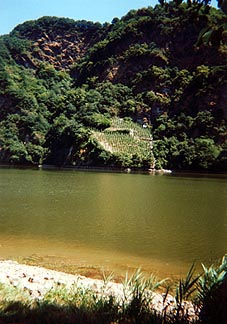 The Sauer separates Germany from
Luxembourg, and the cycle path that follows it weaves back and forth from one country to
the other. Following the Sauer, I occasionally got lost and ended up across the bridge in
Germany. Finally, the Mosel River emerged in front of me. It meanders back and forth
through deep valleys, lined with vines that appeared to be growing out of loose shale. At
times the valleys are so steep that the locals have built little monorail systems to
transport them and their equipment to the higher elevations. Each monorail is really just
a small engine, a seat and a small platform for equipment. They snake up over ancient
retaining walls.
The Sauer separates Germany from
Luxembourg, and the cycle path that follows it weaves back and forth from one country to
the other. Following the Sauer, I occasionally got lost and ended up across the bridge in
Germany. Finally, the Mosel River emerged in front of me. It meanders back and forth
through deep valleys, lined with vines that appeared to be growing out of loose shale. At
times the valleys are so steep that the locals have built little monorail systems to
transport them and their equipment to the higher elevations. Each monorail is really just
a small engine, a seat and a small platform for equipment. They snake up over ancient
retaining walls.
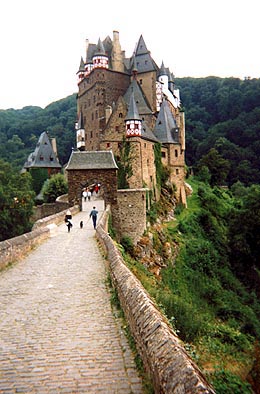
Castles often crowned the hilltops along my route. One such edifice was Berg Eltz, a fantasyland castle high above a meander in a small river. The approach I chose to the castle involved a two-kilometer switchback up to a plateau, followed by a two-kilometer hike back down to the castle. The oldest continuously standing castle in Germany, Berg Eltz is still inhabited by descendants of the original family. I joined a short tour in German with a poorly written, expensive English-translation brochure.
Having camped most nights in the convenience of inexpensive and pleasant European campgrounds, I decided to try another hostel as the nights were becoming rainy and cold. In my experience so far, hostels had usually been crowded, smoky places where relative quiet was non-existent. Large numbers of school children filled some, while others were frequented by bored-looking smokers lolling away the daylight hours. Real travelers were out seeing the sites.
 The hostel in Koblenz occupies a tiny but
prominent corner of a huge fortress overlooking the Mosel as it enters the Rhine. Prussian
troops once slept in the dorms that now accommodate tourists. The climb to the hostel was
tortuous after a long day of cycling. After navigating a maze of tunnels into the fort I
was rewarded with a magnificent view far below of the Mosel flowing into the Rhine. The
hostel itself had a hospital-type feel despite its historical past, and its spotless
interior smelled of disinfectant.
The hostel in Koblenz occupies a tiny but
prominent corner of a huge fortress overlooking the Mosel as it enters the Rhine. Prussian
troops once slept in the dorms that now accommodate tourists. The climb to the hostel was
tortuous after a long day of cycling. After navigating a maze of tunnels into the fort I
was rewarded with a magnificent view far below of the Mosel flowing into the Rhine. The
hostel itself had a hospital-type feel despite its historical past, and its spotless
interior smelled of disinfectant.
The Rhine is touristy. Trains run up both sides, while dozens of riverboats navigate the often-narrow channel. The towns closest to Koblenz held little that was of interest to me. Further on were towns still surrounded by the remains of original fortifications. Kindly locals showed me their gardens and gave me directions, though I hadn't asked. One garden consisted of an entire miniature town, with working water wheels and a tiny gondola system.
I cycled up to Berg Stahleck, both a castle and a hostel overlooking the town of Bacharach. The town sat far below on the banks of the river. Wandering after dinner I stopped to watch some traditional German dancers. They were performing at a wedding reception and I was immediately invited in and handed a glass of wine. I declined the dinner invitation that later ensued, feeling out of place and tongue-tied among the mostly German-speaking guests.
The next day I went by bike and then by train to Frankfurt. I was warmly welcomed at the Marriott Hotel where I was scheduled to stay with my mom a few weeks later. The Marriott concierge was prepared for my arrival with loads of questions about my trip and even knew my name because of a fax that my parents had sent to ensure that it would be okay to leave a bike there for a few weeks.
My next destination soon became Gimmelwald, Switzerland. I had never heard of it, but it came highly recommended at the hostel bar one night between glasses of local wine and superb Weiss beer.
When You Go
For more information on cycling Europe I recommend:
Europe by Bike: Eighteen Tours Geared for Discovery
By Karen and Terry Whitehill. Mountaineers Books 1993
www.mountaineersbooks.org
Luxembourg City Tourism Office
Germany National Tourism Office