
 Famous Faces, Famous Places and Famous Foods


Ecuador's Galapagos Islands: The Last Wild Place on Earth
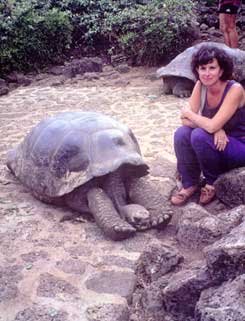 Wild animals have always intrigued me. At six, I relished long summer evenings capturing unlucky fireflies. Hundreds glowed inside my jelly jar, a thrilling nightlight. My next wild pal was the box turtle hissing underneath our Rose of Sharon bush. We met secretly all summer over stolen salad leftovers. To prove my devotion I never confined him to a shoebox. Of course one fall day he vanished. A wild animal doesn't need a nerdy girl.
Busy with work, marriage, and adultisms, I forgot all about wild animals until my early thirties. One day, mysteriously drawn to the zoo, I fell in love with elephants, tigers, and bears. I envied their beauty, their arrogance. Prisoners for life, yes, but still programmed to kill if I got too close. Their innate wildness was stronger than my pseudo-bravura.
By middle age I too was a prisoner for life: sixty hours a week in a windowless office, I slaved at dull work to pay my bills. Divorced, sharing a cramped city apartment with a girlfriend, there was little wildness in my days.
Perusing a nature magazine, I was mesmerized by one photo. Dazzling blue feet. Beak and tail pointed skyward. Wings spread wide. Was this a bird angel?
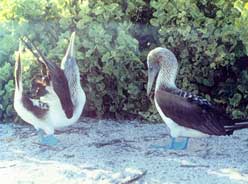 "Blue-footed booby birds, found only on The Galapagos Islands," the caption noted, "perform joyous courtship dances."
Birds with intense blue feet, so crazy in love they dance?
I took leave from work, maxed my credit card, and a week later was 600 miles west of Ecuador. I would dance with blue feet or die.
The Galapagos Islands. The Spanish called them Las Encantadas, Enchanted Islands. Last wild place on earth where people and animals can face each other without fear. Eye to eye with birds, sea lions, iguanas, crabs, and tortoises, I admired their ability to lead joyful lives despite daily survival challenges. Animal parents created homes where they loved each other and their children.
Inspired by what I saw, I returned home empowered. I quit my dull job to become a writer and teacher. I met and married my soulmate. A bit of Wildness sneaks out unexpectedly everyday now.
Ten happy years passed. Missing those bewitching blue feet, I returned again last month.
SAN CRISTOBAL ISLAND
The sun has set on this volcanic island for three million years. Tonight my beach companions are nine sea lions snuggled against each other like question marks. A baby opens one sleepy oval eye in a curious stare. Golden whiskers jut from a black nose -- I'm tempted to caress her gleaming brown fur.
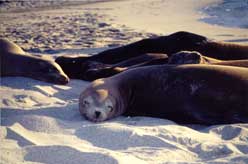 Suddenly an eight-foot bull charges out of the sea, barking ferociously. Rearing on front fins, he insists I move. No problem. Within seconds Mr. Big sits on my towel looking contentedly over his harem. Each lifts her nose for a kiss.
"Asserting his manhood," laughs my guide Renato Perez. "Sea lions actually love playing with people. Their predators here are sharks, not humans."
Out in the surf snorkelers splash with a flirtatious sea lion. Laughing, they try to catch her, but she swims circles around them. Who is wilder, the snorkelers or the sea lion?
Is this what our world was like before fear?
SANTIAGO ISLAND
Along the crashing surf, hundreds of crimson crabs float half-submerged in blue tidal pools. They scuttle sideways into narrow lava crevices as I approach, but after a few seconds they pop back out.
"Sally Lightfoots are the most photographed crabs in the world," Renato smiles proudly. "Shy at first, but we call them our Galapagos Islands 'Welcoming Committee.'"
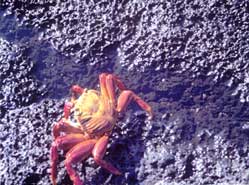 I photograph a sea of waving claws.
We scramble up the lunar-like landscape of sharp black rocks, where marine iguanas pose grandly like prehistoric dinosaurs. Monstrous faces, spiky crests, and enormous claws create a fearsome image.
"They mostly eat sea algae and crustaceans," Renato assures me. Slowly, I move closer, hoping to pose with a majestic four-footer. Right on cue, he fixes the camera with his unsmiling grimace.
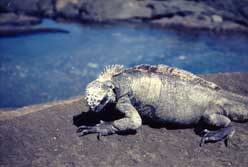 "Iguanas have a fascinating adaptation story," he continues. "We believe they originally lived inland, but because of food scarcity, turned to the sea and learned to swim. Evolution took thousands of years of course, but now they are master divers, feeding on algae at fifty-foot depths."
GENOVESA ISLAND
Soft flutey whistles waft across black lava rocks. Red-footed boobies with blue faces nest in trees, black-and-white masked boobies feed chicks fluffy as cotton.
Blue-footed boobies sky point, wings outstretched, singing in ecstasy. I have traveled so far to see them, and they are as adorable as I had remembered. One male approaches his beloved, offering her a carefully selected stick. She examines his engagement gift, then adds it to their nest.
Waltzing on feet blue as a summer sky, they invite me to join their dance of love.
If You Go:
Sidebar One
Ecoventura S.A. offers year round Galapagos tours from a fleet of four luxury yachts. The M/Y Eric, Flamingo I, and Letty are 83 foot, 20 passenger motor yachts; the MV Corinthian accommodates 48 passengers. Rates for a seven night cruise average US $2000-3200. per person double occupancy and include: yacht accommodations, all meals and snacks, shore excursions, snorkeling equipment, guide services, transfers between the dock, and airport in Galapagos. English and Spanish are spoken on board.
Reservations: Galapagos Network, 7200 Corporate Center Drive, Suite 510, Miami, Florida 33126 USA; Telephone 800-633-7972; Fax 305-592-6394; Email: gpsnet@aol.com
Flights: SAETA Airlines has daily flights from Miami, and five times weekly from New York to Quito, Ecuador. Flights to San Cristobal Galapagos, where ships are boarded, are serviced by SAN Airlines, an affiliate of SAETA.
Sidebar Two
New in 1998:
In March 1998, the Galapagos National Park opened a new Interpretation Center on San Cristobal Island. The Center focuses on Galapagos history, from its volcanic origins to the present. Exhibits include photographs, letters, diaries and geologic dioramas.
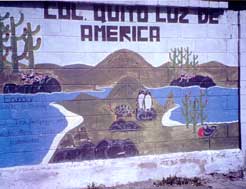 In 1959, the Ecuadorian government declared 97% of the Galapagos Islands as National Park, and in 1961, the Charles Darwin Research Station was established. The Park protects endangered species, and manages tourism; the Darwin Station is an international non-profit organization conducting scientific research and training Naturalist Tour Guides.
Further information:
Charles Darwin Foundation, Inc. 100 N. Washington Street, Suite 232, Falls Church, Virginia 22046 USA.
Current Galapagos Island information is at naturalist.net
With a donation of $25, become a "Friend of Galapagos" to receive seminar invitations and a newsletter subscription.
c1998 Sharon Lloyd Spence
SANTIAGO ISLANDAlong the crashing surf, hundreds of crimson crabs float half-submerged in blue tidal pools. They scuttle sideways into narrow lava crevices as I approach, but after a few seconds they pop back out.
"Sally Lightfoots are the most photographed crabs in the world," Renato smiles proudly. "Shy at first, but we call them our Galapagos Islands 'Welcoming Committee.'"
 I photograph a
sea of waving claws.
I photograph a
sea of waving claws.
We scramble up the lunar-like landscape of sharp black rocks, where marine iguanas pose grandly like prehistoric dinosaurs. Monstrous faces, spiky crests, and enormous claws create a fearsome image.
"They mostly eat sea algae and crustaceans," Renato assures me. Slowly, I move closer, hoping to pose with a majestic four-footer. Right on cue, he fixes the camera with his unsmiling grimace.
 "Iguanas
have a fascinating adaptation story," he continues. "We believe they originally
lived inland, but because of food scarcity, turned to the sea and learned to swim.
Evolution took thousands of years of course, but now they are master divers, feeding on
algae at fifty-foot depths."
"Iguanas
have a fascinating adaptation story," he continues. "We believe they originally
lived inland, but because of food scarcity, turned to the sea and learned to swim.
Evolution took thousands of years of course, but now they are master divers, feeding on
algae at fifty-foot depths."
GENOVESA ISLAND
Soft flutey whistles waft across black lava rocks. Red-footed boobies with blue faces
nest in trees, black-and-white masked boobies feed chicks fluffy as cotton.
Blue-footed boobies sky point, wings outstretched, singing in ecstasy. I have traveled so far to see them, and they are as adorable as I had remembered. One male approaches his beloved, offering her a carefully selected stick. She examines his engagement gift, then adds it to their nest.
Waltzing on feet blue as a summer sky, they invite me to join their dance of love.
If You Go:
Sidebar One
Ecoventura S.A. offers year round Galapagos tours from a fleet of four luxury yachts. The M/Y Eric, Flamingo I, and Letty are 83 foot, 20 passenger motor yachts; the MV Corinthian accommodates 48 passengers. Rates for a seven night cruise average US $2000-3200. per person double occupancy and include: yacht accommodations, all meals and snacks, shore excursions, snorkeling equipment, guide services, transfers between the dock, and airport in Galapagos. English and Spanish are spoken on board.
Reservations: Galapagos Network, 7200 Corporate Center Drive, Suite 510, Miami, Florida 33126 USA; Telephone 800-633-7972; Fax 305-592-6394; Email: gpsnet@aol.com
Flights: SAETA Airlines has daily flights from Miami, and five times weekly from New York to Quito, Ecuador. Flights to San Cristobal Galapagos, where ships are boarded, are serviced by SAN Airlines, an affiliate of SAETA.
Sidebar Two
New in 1998:
In March 1998, the Galapagos National Park opened a new Interpretation Center on San
Cristobal Island. The Center focuses on Galapagos history, from its volcanic origins to
the present. Exhibits include photographs, letters, diaries and geologic dioramas.
 In 1959, the
Ecuadorian government declared 97% of the Galapagos Islands as National Park, and in 1961,
the Charles Darwin Research Station was established. The Park protects endangered species,
and manages tourism; the Darwin Station is an international non-profit organization
conducting scientific research and training Naturalist Tour Guides.
In 1959, the
Ecuadorian government declared 97% of the Galapagos Islands as National Park, and in 1961,
the Charles Darwin Research Station was established. The Park protects endangered species,
and manages tourism; the Darwin Station is an international non-profit organization
conducting scientific research and training Naturalist Tour Guides.
Further information: Charles Darwin Foundation, Inc. 100
N. Washington Street, Suite 232, Falls Church, Virginia 22046 USA.
Current Galapagos Island information is at naturalist.net
With a donation of $25, become a "Friend of Galapagos" to receive seminar invitations and a newsletter subscription.
c1998 Sharon Lloyd Spence