
 Famous Faces, Famous Places and Famous Foods

Jamaica, the Writer's Trail
 Jamaica called in her siren's voice to me, and whispered in my ear -- write about that golden era of famous writers, take a trip down the author's trail. "Take a trip into my star-studded past," the siren called Jamaica beckoned, her breath as soft and sweet as a trade winds breeze. "Begin in 1942 when Commander Ian Fleming first saw and fell for Jamaica."
At that time, Ian Fleming was not yet a famous writer. In fact, he hadn't put pencil to bond (excuse the pun). The darkly handsome British officer arrived on a Royal Navy Mission to Jamaica in 1942, during a perilous time when Britain was concerned about Nazi U-boats in Caribbean waters. (It is interesting to note that part of Fleming's value to British Intelligence was that he received some of his tertiary education at both a German and a Swiss University.) Fleming must have taken time out from this important mission to dream, because like others who fell for Jamaica, he knew from the very beginning that he had to own a piece of it. Just four years after Fleming's fateful first visit, and in fact only a year after he retired from the position he held throughout World War II as British Head of Naval Intelligence, he bought a property on the northeast coast in an area named Orcabessa (a Spanish name meaning Golden Head).
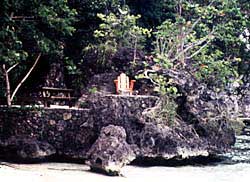 Fleming purchased his plot of land that sits on a bluff overlooking the turquoise sea from Blanche Blackwell, famous beauty, socialite, land owner, white Jamaican, and mother of famous hotelier (Island Outpost), entrepreneur Chris Blackwell. (Chris Blackwell was also Bob Marley's producer, financier and promoter, and began Island Records.) Rumor had it that the dashing Fleming was having a love affair with the beautiful and fascinating Blanche Blackwell, but this may be only a rumor, like many others that spring to life around famous people.
Fleming built a house on his newly purchased 30-acre property by the sea and named it Goldeneye. He wrote his best-selling James Bond series there, and many scenes and plot details are rooted in the Jamaican landscape that surrounded him. Ian Fleming got the name for his dashing hero from the author of his 'bible' Birds of the West Indies, by James Bond. Fleming referred to this as one of his 'Jamaican links'. When he later met the bird-loving Mr. Bond and his wife, he apologized to them for lifting the name. Fleming reported that the couple kindly commented that it helped them clear customs when they traveled.
Fleming, like other writers who holed up in some beauty spot that awakens their creative spirit, felt creatively indebted to Jamaica -- so much so he said, "would these books have been born if I hadn't been living in the gorgeous vacuum of a Jamaican holiday? I doubt it." At Goldeneye, Fleming began and finished his first of the Bond series, Casino Royale. In fact, he wrote all twelve of his stylish thrillers there.
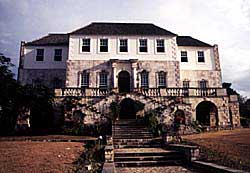 While in residence at his simple house on the north shore, Bond also wrote his first article, a mood piece that extolled the virtues of Jamaica. The piece titled, "Where shall John go? Jamaica" was published in Horizon Magazine in 1947. In it, Fleming recommended a visit to Rose Hall Great House, eight miles east of Montego Bay, and a simultaneous read of the Gothic novel, The White Witch of Rose Hall by British writer De Lisser. This story of sadism and slaves set in the 1850s is based on the true story of Annie Palmer, a woman who murdered her three husbands in the Great House bed and treated her slaves with imaginative and sexually inspired cruelty. The Great House built in 1780, has been perfectly restored including the original bed where Annie Palmer is said to have (black widow-style) made love to and then dispatched her husbands off to the next world.
But this was not the first of the gothic bodice rippers that showed Jamaica as exotica for writers. As early as the late 18th century, British novelist and plantation owner Matthew (Monk) Lewis set his bestseller The Monk in ever-sensual Jamaica. Later, Jean Rhys, famous Dominican novelist, used Jamaica as the setting for her novel Wide Sargasso Sea, although she had never set foot on the island. In Wide Sargasso Sea, Rhys fills in the pieces for a Charlotte Bronte novel about a Creole woman who is too passionate for her British husband, is treated with disdain, goes mad, and later is locked up by that husband because her West Indies-style passion is so misunderstood. The movie based on the novel is beautifully filmed in the lush Blue Mountains of Jamaica. (When novelists, film makers and magazines need a tropical setting that exudes sensuality, Jamaica is often the choice.)
In the glitterati '40s and '50s, Fleming invited his friends to his Jamaican home away from home, Goldeneye. Wealthy white Jamaicans were also on the guest list. Goldeneye became well known on the cocktail circuit of highflying movie stars, writers, and famous faces. The invention of the airplane was making travel more convenient and Jamaica was just a short hop away.
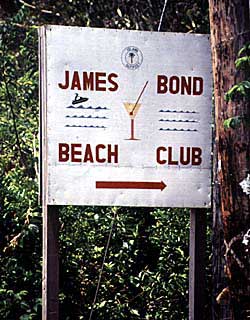 Friends honeymooned at Goldeneye; stricken friends regained their strength; painters and writers -- Cecil Beaton, Truman Capote, Graham Greene, Evelyn Waugh and Noel Coward, among others -- drank cocktails, slept them off and then wrote and painted at Goldeneye.
Ian Fleming and Coward had known each other during wartime (Coward put on charity concerts for troops in South Africa). The inexhaustible Coward was to become one of the most consummate actors of his time, and brilliantly used his own plays as a vehicle for his acting talents. When his plays fell out of favor with the public, Coward became a movie director. When his public tired of that, he started a one-man Vegas show. The 'man about town' Coward set fashion trends and when he was photographed in PJ's and silk dressing gown, the whole world followed suit and began receiving visitors in night attire. When not charming the world with his talents, Coward escaped for three months every year to Jamaica.
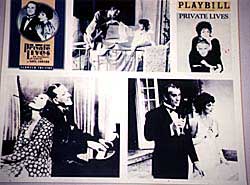 Fleming himself was to spark Coward's fascination with Jamaica. It was a spark that instantly exploded into a constant flame. In 1948, Ian Fleming issued an invitation to the multi-talented personality, songwriter, raconteur to visit his home in Jamaica. Coward had received abusive notices from critics about his latest play, Tonight at Eight-Thirty. He closed the play, and he and his companion Graham Payne eagerly accepted Fleming's invitation. The fact that Coward was out of money made Fleming's hospitality even more appealing.
Coward and Payne sailed to Kingston from New York in five days. On arrival, there began a boyish teasing friendship and good-natured rivalry between Coward and Fleming over Jamaica. During Coward's fateful first visit, he wrote an ode to Fleming's Goldeneye, which he referred to as 'Goldeneye, Nose and Throat' that groused and complained about the airless rooms and the hardness of Fleming's furniture but ended with "...I am strangely happy in your house. In fact I'm very fond of it."
Fleming too enjoyed the sparring and wrote about the outcome of Coward's first visit in the now out-of-print book Ian Fleming Introduces Jamaica. "He (Coward) then went off, and, as close to me as he could get, built a house (what am I saying -- four houses) and -- to hell with the charms of Bermuda and Switzerland! -- comes here every year."
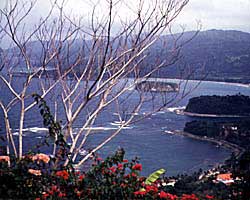 During Coward's three month stay at Goldeneye, Coward, with his constant companion Payne at his side, searched the island for "an idyllic bolt-hole to return to when life becomes too frustrating." Evenings under a star peppered sky, Coward and Payne would discuss over drinks the possibility of "building a shack somewhere isolated on the island." During the day they would hunt for suitable property. They found their place to build a "shack" two miles before you enter Port Maria from Orcabessa. Located on a hill, the property tumbled to the sea and was backed by the vivid blue-green of the Blue Mountains. Coward immediately purchased the property for a song; had a local architect draw up plans for a two-story villa and two guest cottages; and named his 'idyllic bolt-hole' Blue Harbour after its picturesque view of Port Maria.
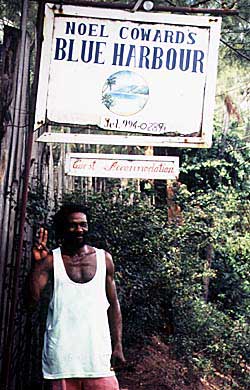 But Blue Harbour was just the beginning of Coward's 'until death do we part' love affair with Jamaica. A mere two weeks after purchasing Blue Harbour, Coward and his companion Payne were out exploring and painting when they stumbled on a second property high above. The 360-degree view from the property was intoxicatingly spectacular, and Coward and Payne spent the evening sitting in the grass drinking a thermos of ice-cold dry martinis and watching fireflies flit across Jamaica's night sky. The four-acre property, 1,000 feet above Blue Harbour was called Look-Out by the locals, as it had been used as such 300 years earlier by the infamous pirate Henry Morgan. Coward bought Look-Out with the view of building himself a writing retreat as soon as he had enough money. Already, he had named it Firefly. But it was not until his 1956 successful stint in Las Vegas that Coward had the money to build what he called "my dream home."
Coward's Firefly property, like Ian Fleming's Goldeneye, was sold to him by the wealthy Blackwell family. The prolific Coward went on to write 50 plays and 300 songs, many of them penned at Blue Harbour and Firefly, almost next door to the socially affable Fleming. (Eventually Coward would die in Jamaica and be buried on the grounds of his beloved Firefly.)
Shaken not Stirred:
Round Hill Recipe for a Bond (and Coward) style Martini
2 ½ oz. gin
¼ oz. dry vermouth
2 cocktail olives
Twist of lime
Pour gin and dry vermouth into a cocktail mixing glass.
Add three cubes of ice and shake.
Pour into a rock glass over ice.
Add olives and a twist of lime.
Use less vermouth for an extra dry martini.
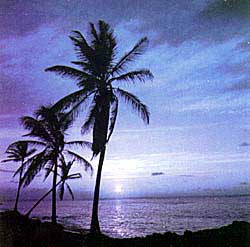
When Coward joined Fleming on the Jamaican landscape there began an even bigger round of entertaining that included avid martini drinking James Bond-style (shaken not stirred) while watching the Jamaican sun, a brilliant golden ball, drop below the silvery surface of the sea.
Information:
Goldeneye - Ph: 800-OUTPOST, or go to www.islandlife.com
Round Hill - Ph: 800-972-2159, or go to www.roundhilljamaica.com
Blue Harbour - Ph: 505 586-1244, or go to www.villasetal.com
 Friends
honeymooned at Goldeneye; stricken friends regained their strength; painters and
writers -- Cecil Beaton, Truman Capote, Graham Greene, Evelyn Waugh and Noel Coward, among
others -- drank cocktails, slept them off and then wrote and painted at Goldeneye.
Friends
honeymooned at Goldeneye; stricken friends regained their strength; painters and
writers -- Cecil Beaton, Truman Capote, Graham Greene, Evelyn Waugh and Noel Coward, among
others -- drank cocktails, slept them off and then wrote and painted at Goldeneye.
Ian Fleming and Coward had known each other during wartime (Coward put on charity concerts for troops in South Africa). The inexhaustible Coward was to become one of the most consummate actors of his time, and brilliantly used his own plays as a vehicle for his acting talents. When his plays fell out of favor with the public, Coward became a movie director. When his public tired of that, he started a one-man Vegas show. The 'man about town' Coward set fashion trends and when he was photographed in PJ's and silk dressing gown, the whole world followed suit and began receiving visitors in night attire. When not charming the world with his talents, Coward escaped for three months every year to Jamaica.
 Fleming himself was to
spark Coward's fascination with Jamaica. It was a spark that instantly exploded into a
constant flame. In 1948, Ian Fleming issued an invitation to the multi-talented
personality, songwriter, raconteur to visit his home in Jamaica. Coward had received
abusive notices from critics about his latest play, Tonight at Eight-Thirty. He
closed the play, and he and his companion Graham Payne eagerly accepted Fleming's
invitation. The fact that Coward was out of money made Fleming's hospitality even more
appealing.
Fleming himself was to
spark Coward's fascination with Jamaica. It was a spark that instantly exploded into a
constant flame. In 1948, Ian Fleming issued an invitation to the multi-talented
personality, songwriter, raconteur to visit his home in Jamaica. Coward had received
abusive notices from critics about his latest play, Tonight at Eight-Thirty. He
closed the play, and he and his companion Graham Payne eagerly accepted Fleming's
invitation. The fact that Coward was out of money made Fleming's hospitality even more
appealing.
Coward and Payne sailed to Kingston from New York in five days. On arrival, there began a boyish teasing friendship and good-natured rivalry between Coward and Fleming over Jamaica. During Coward's fateful first visit, he wrote an ode to Fleming's Goldeneye, which he referred to as 'Goldeneye, Nose and Throat' that groused and complained about the airless rooms and the hardness of Fleming's furniture but ended with "...I am strangely happy in your house. In fact I'm very fond of it."
Fleming too enjoyed the sparring and wrote about the outcome of Coward's first visit in the now out-of-print book Ian Fleming Introduces Jamaica. "He (Coward) then went off, and, as close to me as he could get, built a house (what am I saying -- four houses) and -- to hell with the charms of Bermuda and Switzerland! -- comes here every year."
 During
Coward's three month stay at Goldeneye, Coward, with his constant companion Payne at his
side, searched the island for "an idyllic bolt-hole to return to when life becomes
too frustrating." Evenings under a star peppered sky, Coward and Payne would discuss
over drinks the possibility of "building a shack somewhere isolated on the
island." During the day they would hunt for suitable property. They found their place
to build a "shack" two miles before you enter Port Maria from Orcabessa. Located
on a hill, the property tumbled to the sea and was backed by the vivid blue-green of the
Blue Mountains. Coward immediately purchased the property for a song; had a local
architect draw up plans for a two-story villa and two guest cottages; and named his
'idyllic bolt-hole' Blue Harbour after its picturesque view of Port Maria.
During
Coward's three month stay at Goldeneye, Coward, with his constant companion Payne at his
side, searched the island for "an idyllic bolt-hole to return to when life becomes
too frustrating." Evenings under a star peppered sky, Coward and Payne would discuss
over drinks the possibility of "building a shack somewhere isolated on the
island." During the day they would hunt for suitable property. They found their place
to build a "shack" two miles before you enter Port Maria from Orcabessa. Located
on a hill, the property tumbled to the sea and was backed by the vivid blue-green of the
Blue Mountains. Coward immediately purchased the property for a song; had a local
architect draw up plans for a two-story villa and two guest cottages; and named his
'idyllic bolt-hole' Blue Harbour after its picturesque view of Port Maria.
 But
Blue Harbour was just the beginning of Coward's 'until death do we part' love affair with
Jamaica. A mere two weeks after purchasing Blue Harbour, Coward and his companion Payne
were out exploring and painting when they stumbled on a second property high above. The
360-degree view from the property was intoxicatingly spectacular, and Coward and Payne
spent the evening sitting in the grass drinking a thermos of ice-cold dry martinis and
watching fireflies flit across Jamaica's night sky. The four-acre property, 1,000 feet
above Blue Harbour was called Look-Out by the locals, as it had been used as such 300
years earlier by the infamous pirate Henry Morgan. Coward bought Look-Out with the view of
building himself a writing retreat as soon as he had enough money. Already, he had named
it Firefly. But it was not until his 1956 successful stint in Las Vegas that Coward had
the money to build what he called "my dream home."
But
Blue Harbour was just the beginning of Coward's 'until death do we part' love affair with
Jamaica. A mere two weeks after purchasing Blue Harbour, Coward and his companion Payne
were out exploring and painting when they stumbled on a second property high above. The
360-degree view from the property was intoxicatingly spectacular, and Coward and Payne
spent the evening sitting in the grass drinking a thermos of ice-cold dry martinis and
watching fireflies flit across Jamaica's night sky. The four-acre property, 1,000 feet
above Blue Harbour was called Look-Out by the locals, as it had been used as such 300
years earlier by the infamous pirate Henry Morgan. Coward bought Look-Out with the view of
building himself a writing retreat as soon as he had enough money. Already, he had named
it Firefly. But it was not until his 1956 successful stint in Las Vegas that Coward had
the money to build what he called "my dream home."
Coward's Firefly property, like Ian
Fleming's Goldeneye, was sold to him by the wealthy Blackwell family. The prolific Coward
went on to write 50 plays and 300 songs, many of them penned at Blue Harbour and Firefly,
almost next door to the socially affable Fleming. (Eventually Coward would die in Jamaica
and be buried on the grounds of his beloved Firefly.)
Shaken not Stirred:
Round Hill Recipe for a Bond
(and Coward) style Martini
2 ½ oz. gin
¼ oz. dry vermouth
2 cocktail olives
Twist of lime
Pour gin and dry vermouth into a cocktail mixing glass.
Add three cubes of ice and shake.
Pour into a rock glass over ice.
Add olives and a twist of lime.
Use less vermouth for an extra dry martini.
When Coward joined Fleming on the Jamaican landscape there began an even bigger round of
entertaining that included avid martini drinking James Bond-style (shaken not stirred)
while watching the Jamaican sun, a brilliant golden ball, drop below the silvery surface
of the sea.
Information:
Goldeneye - Ph: 800-OUTPOST, or go to www.islandlife.com
Round Hill - Ph: 800-972-2159, or go to www.roundhilljamaica.com
Blue Harbour - Ph: 505 586-1244, or
go to www.villasetal.com