
 Famous Faces, Famous Places and Famous Foods

Belize Offers
Barely a half-day's travel from most points in the United States, Belize
awaits intrepid travellers with lush rainforest, thousand-foot waterfalls, pristine rivers and Mayan temples. A friendly, English-speaking populace greets the novice adventurer, as do first class lodging and a plentiful supply of safe drinking water. Just over 200,000 residents -- a harmonious mixture of Black Caribe Indians, Creoles, Mayans, Mestizos and Brits (left over from the country's days as British Honduras) -- live in this Central American country, about the size of Massachusetts. Most travellers head here to fish or scuba dive. We opted for the undiscovered Belize, the Cayo District, part of Belize's inland frontier.
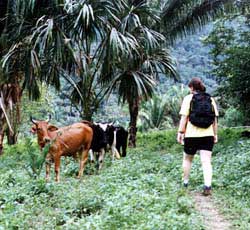 Eighty percent of the country's rainforest remains under government protection, much of it unexplored. Maps note that the highest point in Belize may be 3,675-foot Victoria Peak, noting that the entire country hasn't been fully charted.
Playing the role of a tropical Wild West, Cayo is dotted with dusty (muddy, in the rainy season) towns, where men in cowboy hats lead horses with one hand and carry machetes in the other. Many of the country's present-day Mayans still live and farm in Cayo's hills, often in the shadow of their ancestors' long-abandoned temples.
Our base was Windy Hill Cottages, a colony of comfortable, well-appointed bungalows nestled against the jungle. Each morning, grackles chattered us awake. And, each morning, a breakfast of fresh local fruits, juices and grains awaited us on an airy, thatched patio.
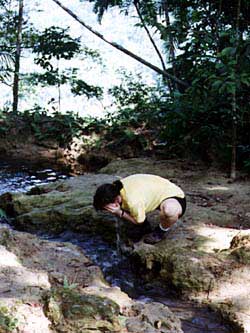 During the day, local guides braved barely-formed dirt roads to acquaint us with the ecotourism ethic and its many showpieces in Cayo. In the evening, we dined again in the Caribbean air, watching the sun burn orange and crimson over nearby Guatemala. Sleep came easily after the pleasantly exhausting days and magical nights.
The people of Belize are remarkably radiant in their happiness, their graciousness and their extreme national pride. We became fast friends with much of the resort's staff. Elias, a gentle young Mayan with mischievous eyes, excited us each evening at dinner with hints of the next day's adventures. Our Mestizo bartender Roger told us about Duende, the Belizean bogeyman who hides in the deepest forests. "You'll know him if you see him," he said in hushed tones. "He's three feet tall and has no thumbs. If you wave to him, hide your thumbs so he'll think you're a friend. Otherwise..." And his voice trailed off.
Windy Hills staff member and U.S. ex-patriate Mike Green guided us to Che Chem-Ha, where a farmer recently discovered a cave filled with Mayan pottery nearly 2,000 years old. We joined two other guests in the back of a pick-up for the kidney-jarring ride. We slogged the final quarter-mile through jungle and mud. A few months earlier, Mike had suggested that the farmer, Antonio Moralez, build restrooms and cut back some of the overgrowth so that visitors could enjoy the view -- a new concept for a farm family that had prized the land for its ability to provide food, not as a tourist attraction. The next time Mike returned, the brush had been removed, revealing a stunning vista of the Macal River gorge. Two outhouses -- with doors just a few feet high -- were perched on an adjacent hill. "I told him, 'Gee, Antonio, I think you should have put full doors on.' He looked right back at me and said, 'The view! The view!' So if you need to use the facilities, you'll have the best view in Belize."
Along the 45-minute climb to the cave, Mike identified various trees, including one whose razor-sharp thorns inject a potent toxin into the blood. The only known cure is the tree's own sap. Hence its name: the give-and-take tree. An example of the symbiosis that thrives in the rainforest is the bullhorn acacia tree. Guarded by ant colonies that live off its nectar, the tree is protected from animals that might brush against its delicate bark. We were forewarned, but less fortunate hikers who grab at the tree for a handhold are greeted by a shower of angry, biting ants.
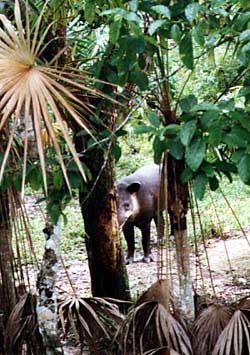
 Although the rainforest is home to innumerable animal species such as jaguars, peccaries (a kind of wild pig), howler monkeys and pumas, insects -- especially mosquitoes -- rule the jungle through sheer number. Throughout our hike, we spotted wavy green lines crossing the trail; a closer look prompted by the undulating character of the path revealed millions of leafcutter ants methodically carrying bits of mango leaves back to their massive nests. At one point, Mike innocently suggested we poke a twig into a small hole; an indignant tarantula grabbed it violently and stalked out to investigate.
When we arrived at the cave, Antonio's nephew guided us through the entrance, our flashlight beams darting into the darkness. The cave was almost as the ancient Mayans had left it. Most of the pottery -- some pieces several feet tall -- was on ledges, and we took turns climbing homemade ladders to investigate more closely. In some places we had to crawl or to grab onto ropes, part rappelling, part slithering, part wedging our way deeper into the cave. The cave ended in a vaulted chamber. In the center, rocks ringed a small altar, untouched for a millennium or longer. Mike had us turn off our lights. For several moments, we were enveloped by total darkness and a silence broken only by our hushed breathing.
The income from the caves had enabled Antonio and his family to build a small terrace for meals and a few thatch huts for overnight tourists. Under the curious gaze of a keel-billed toucan, we enjoyed a lunch of braised chicken -- fresh from the farmyard.
After a brief siesta, we hiked down the gorge to Vaca Falls. The current had carved its way through the bedrock forming different levels of pools and natural dive platforms. Drenched in sweat, we jumped into the rapids, which churned us like socks in a washing machine.
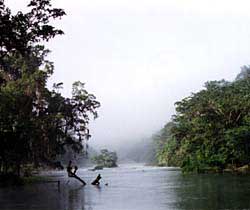
After dawn-to-dusk climbing, leaping, crawling and swimming, we decided to pass the next day more peacefully with an afternoon canoe trip down a quiet stretch of the Macal River. Mike dropped us off about 10 miles upstream from the take-out spot. "Don't worry how long it takes you," he shouted as we pushed off. "We're on Belizean time here -- no stress, no hurry. I'll see you when you get there." We saw few signs of human life along the river: just a fisherman in a dugout canoe and some Mayan women washing clothes and toddlers in the river.
Animal life was more plentiful: turkey vultures catching updrafts over the river, woodpeckers tapping at rotted trees, emerald-green six-foot iguanas basking on tree limbs and blue herons skimming for fish. At a bend in the river, a cloud of thousands of lime-green and yellow butterflies floated over a sandbar.
 We interrupted our drift for a stop at the Rainforest Medicine Trail, dedicated to "saving plants that heal people." Along the way, we saw 35 medicinal plants used by herbalists and healers. The bark of the tapaculo tree, for example, is boiled and drunk to cure diarrhea. (Tapaculo, we found out later, is a name coined by children; it means "plug up your butt.") A small shop offered such travellers remedies as Belly Be Good and Flu Away. The Trail is working in partnership with the New York Botanical Garden and the American Cancer Society to find cures for cancer and other health scourges. Thus far, 2000 plants have been researched, and a dozen or so are showing promise.
In the jungle, dusk can turn quickly to darkness -- even on Belizean time. Paddling under a moonless sky, we became objects of curiosity for dozens of bats. The jungle around us, so spectacular and intriguing by day, began to feel wild and menacing, and we picked up our pace. Mike was a welcome sight.
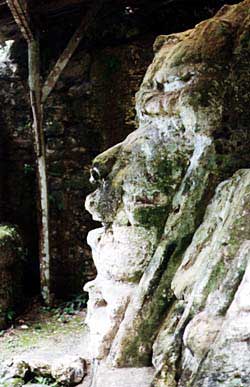
We saw many Mayan ruins during our stay. Just a short distance from Windy Hill, Xunantunich was a major ceremonial center for many of the country's estimated one-million Mayans. A hand-cranked wooden ferry carried us across the Mopan River to the site.
 As we climbed the steep stone stairs leading to the top of a massive pyramid, our guide, Javier, pointed out the ruins of the royal family residence and chambers where thousands of Mayans once lived. Infamous in Mayan history was their penchant for human sacrifices, which sometimes involved tying the unfortunate victim into a ball and rolling him or her down the temple steps. Morbidly, we pushed Javier for details about the sacrifices. "No one really understands what that was all about," he shrugged. "We try to play down the blood."
This was our last day in Cayo. By nightfall, we'd be leaving the mountainous interior for the coast. When we reached the top of the pyramid, dense jungle spread to all horizons, a lush carpet of green dotted with lighter patches of small farms and villages. The moment, like Belize itself, was at once wild and peaceful.
 If You Go:
Belize has become a mecca for eco-travelers and tourists in search of "soft" adventure. Most tour operators concentrate either on the popular dive areas in the north or on specific activities, like scuba diving, bone fishing or coastal kayaking.
After considerable research, we chose Capricorn Leisure Travel (800-426-6544), which once served as Belize's tourism bureau in the U.S. With extensive contacts throughout the country, Capricorn put together a custom package for us focusing mostly on the country's interior.
Getting There:
American Airlines offers daily air service through Miami to Belize City, about 45 miles from the Cayo District.
Getting Around:
Car rentals are available, but roads are rugged and poorly marked. It's best to choose lodging that also offers airport pick-up and guide service. Bus transport is frequent and inexpensive, and tiny prop planes fly frequently to air strips around the country.
Lodging:
Much of Belize is still a bargain. Expect to pay as much as $60 per night per person, including meals, in a bungalow at one of Belize's "micro-resorts" like Windy Hill Cottages (Graceland Ranch, San Ignacio; 011-501-92-2017). You can also spend as little as $8-10 a person for a thatch hut on a farm.
Another option, closer to the coast, is Maruba Resort (40 ½ mile Old Northern Highway, Maskall, Orange Walk; 011-501-3-22199) in an exotic and mysterious jungle setting. Maruba offers pampered spa treatments (like a seaweed wrap followed by a massage with warm honey and raw sugar) as well as excursions to Mayan ruins. A full-day boat trip on the New River, for example, carries travellers through dense jungle rich with wildlife to Lamanai, a massive Maya citadel built 3,500 years ago.
Language:
The official language is English, although you're likely to hear Spanish, Creole, Mayan and Garifuna (Black Caribe Indian) spoken.
Weather:
With a sub-tropical climate, Belize's temperature averages 79 degrees and ranges from 50-95 degrees. The dry season is November-May, the rainy season June-November. We found ideal travel conditions in December.
Food:
Food ranges from basic beans and rice to exotic international. Most hotels and restaurants make use of abundant local fresh produce and meats. Water is safe to drink in most locations.
Clothing:
Informality is the norm. As signs at many restaurants state: "No shirt, no socks, no problem." Although the tendency is to dress for temperature, long-sleeve shirts and long pants provide better protection against the sun and the almost ever-present mosquitoes.
Health:
No vaccinations are required, but travelers to jungle areas should consider anti-malaria measures. Despite generally good water quality and food preparation, tourists should check with their physicians about ways to deal with travelers' diarrhea and related ailments.
After dawn-to-dusk climbing, leaping, crawling and swimming, we decided to pass the next day more peacefully with an afternoon canoe trip down a quiet stretch of the Macal River. Mike dropped us off about 10 miles upstream from the take-out spot. "Don't worry how long it takes you," he shouted as we pushed off. "We're on Belizean time here -- no stress, no hurry. I'll see you when you get there." We saw few signs of human life along the river: just a fisherman in a dugout canoe and some Mayan women washing clothes and toddlers in the river.Animal life was more plentiful: turkey vultures catching updrafts over the river, woodpeckers tapping at rotted trees, emerald-green six-foot iguanas basking on tree limbs and blue herons skimming for fish. At a bend in the river, a cloud of thousands of lime-green and yellow butterflies floated over a sandbar.
 We interrupted our drift for a stop at the Rainforest
Medicine Trail, dedicated to "saving plants that heal people." Along the way, we
saw 35 medicinal plants used by herbalists and healers. The bark of the tapaculo tree, for
example, is boiled and drunk to cure diarrhea. (Tapaculo, we found out later, is a name
coined by children; it means "plug up your butt.") A small shop offered such
travellers remedies as Belly Be Good and Flu Away. The Trail is working in partnership
with the New York Botanical Garden and the American Cancer Society to find cures for
cancer and other health scourges. Thus far, 2000 plants have been researched, and a dozen
or so are showing promise.
We interrupted our drift for a stop at the Rainforest
Medicine Trail, dedicated to "saving plants that heal people." Along the way, we
saw 35 medicinal plants used by herbalists and healers. The bark of the tapaculo tree, for
example, is boiled and drunk to cure diarrhea. (Tapaculo, we found out later, is a name
coined by children; it means "plug up your butt.") A small shop offered such
travellers remedies as Belly Be Good and Flu Away. The Trail is working in partnership
with the New York Botanical Garden and the American Cancer Society to find cures for
cancer and other health scourges. Thus far, 2000 plants have been researched, and a dozen
or so are showing promise.
In the jungle, dusk can turn quickly to darkness -- even on Belizean time. Paddling under a moonless sky, we became objects of curiosity for dozens of bats. The jungle around us, so spectacular and intriguing by day, began to feel wild and menacing, and we picked up our pace. Mike was a welcome sight.
We saw many Mayan ruins during our stay. Just a short distance from Windy Hill, Xunantunich was a major ceremonial center for many of the country's estimated one-million Mayans. A hand-cranked wooden ferry carried us across the Mopan River to the site.
 As
we climbed the steep stone stairs leading to the top of a massive pyramid, our guide,
Javier, pointed out the ruins of the royal family residence and chambers where thousands
of Mayans once lived. Infamous in Mayan history was their penchant for human sacrifices,
which sometimes involved tying the unfortunate victim into a ball and rolling him or her
down the temple steps. Morbidly, we pushed Javier for details about the sacrifices.
"No one really understands what that was all about," he shrugged. "We try
to play down the blood."
As
we climbed the steep stone stairs leading to the top of a massive pyramid, our guide,
Javier, pointed out the ruins of the royal family residence and chambers where thousands
of Mayans once lived. Infamous in Mayan history was their penchant for human sacrifices,
which sometimes involved tying the unfortunate victim into a ball and rolling him or her
down the temple steps. Morbidly, we pushed Javier for details about the sacrifices.
"No one really understands what that was all about," he shrugged. "We try
to play down the blood."
This was our last day in Cayo. By nightfall, we'd be leaving the mountainous interior for the coast. When we reached the top of the pyramid, dense jungle spread to all horizons, a lush carpet of green dotted with lighter patches of small farms and villages. The moment, like Belize itself, was at once wild and peaceful.
 If You Go:
Belize has become a mecca for eco-travelers and tourists in search of "soft" adventure. Most tour operators concentrate either on the popular dive areas in the north or on specific activities, like scuba diving, bone fishing or coastal kayaking.
After considerable research, we chose Capricorn Leisure Travel (800-426-6544), which once served as Belize's tourism bureau in the U.S. With extensive contacts throughout the country, Capricorn put together a custom package for us focusing mostly on the country's interior.
Getting There:
American Airlines offers daily air service through Miami to Belize City, about 45 miles from the Cayo District.
Getting Around:
Car rentals are available, but roads are rugged and poorly marked. It's best to choose lodging that also offers airport pick-up and guide service. Bus transport is frequent and inexpensive, and tiny prop planes fly frequently to air strips around the country.
Lodging:
Much of Belize is still a bargain. Expect to pay as much as $60 per night per person, including meals, in a bungalow at one of Belize's "micro-resorts" like Windy Hill Cottages (Graceland Ranch, San Ignacio; 011-501-92-2017). You can also spend as little as $8-10 a person for a thatch hut on a farm.
Another option, closer to the coast, is Maruba Resort (40 ½ mile Old Northern Highway, Maskall, Orange Walk; 011-501-3-22199) in an exotic and mysterious jungle setting. Maruba offers pampered spa treatments (like a seaweed wrap followed by a massage with warm honey and raw sugar) as well as excursions to Mayan ruins. A full-day boat trip on the New River, for example, carries travellers through dense jungle rich with wildlife to Lamanai, a massive Maya citadel built 3,500 years ago.
Language:
The official language is English, although you're likely to hear Spanish, Creole, Mayan and Garifuna (Black Caribe Indian) spoken.
Weather:
With a sub-tropical climate, Belize's temperature averages 79 degrees and ranges from 50-95 degrees. The dry season is November-May, the rainy season June-November. We found ideal travel conditions in December.
Food:
Food ranges from basic beans and rice to exotic international. Most hotels and restaurants make use of abundant local fresh produce and meats. Water is safe to drink in most locations.
Clothing:
Informality is the norm. As signs at many restaurants state: "No shirt, no socks, no problem." Although the tendency is to dress for temperature, long-sleeve shirts and long pants provide better protection against the sun and the almost ever-present mosquitoes.
Health:
No vaccinations are required, but
travelers to jungle areas should consider anti-malaria measures. Despite generally good
water quality and food preparation, tourists should check with their physicians about ways
to deal with travelers' diarrhea and related ailments.