
 Famous Faces, Famous Places and Famous Foods


Grenada Offers Glimpse of Old Caribbean
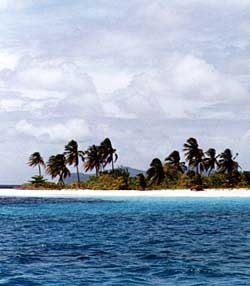 Three hours into a four-hour voyage to Grenada from its sister isle, Carriacou, I sat amidst 60 feet of rolling passengers and cargo crammed on the deck of the derelict freighter Alexia. Next to me, a cow struggled against her ropes.
"She go overboard," cackled an ancient woman squatting beside me. She pointed her pipe toward a group of grinning workers. "They throw her." After ten days on Grenada, I'd already learned to expect the unexpected. I nodded knowingly, if not convincingly. "See, they gettin' ready," the old lady rasped. I'd read how fishermen anointed their new boats with chicken blood toassure safe passage. Had I missed the chapter on cows?
As we approached Grenada, the captain cut the throttle, and the crew wrestled the cow over the side. The cow hit with a bellow and a splash and, with a quick shake of the head, started paddling for shore. A man stood on the beach, rope in hand.
"Farmer buy her, give her new home," my neighbor explained. "Easier to pick her up on beach here than on dock at town."
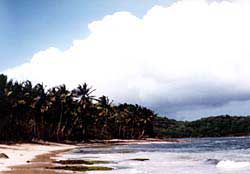
Only recently turned to tourism, Grenada offers frequent glimpses into a Caribbean perhaps decades behind other islands. The roads are rugged, narrow and steep-many eroded by rain or waves. Few footprints mar its 80-mile shoreline, and the lush rain forest makes machetes required equipment for treks through the island's mountainous interior.
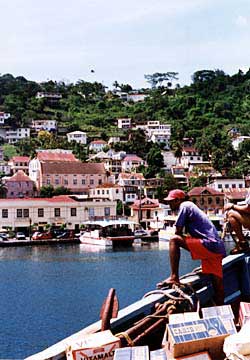 Even the town of St. George's looks more like a Mediterranean seaport than the Caribbean capital it is. Knots of merchants and dock workers wait excitedly as aging fishing boats and rusting freighters tie up at street-side. Winding alleys yield delightful discoveries, like Spice Island Perfumes, where natural spice extracts scent the air, and Art Fabrik, where a courtyard hides rows of colorful batiks drying in the ocean breeze.
It's a traveler's delight.
Local people conduct their lives with consideration but not deference toward tourists. Most make their living from the island's bounty of fish, fruit and spices. Even the uniformed schoolchildren carry home baskets filled with fallen breadfruit, mangoes and papayas.
 Just off the village of St. John's, men in dories tow massive nets toward land. After hours of sweat and strain, their silvery catch coats the length of the beach. Inland, plantations across the island cultivate spices like cloves, allspice, cocoa, vanilla and cinnamon.
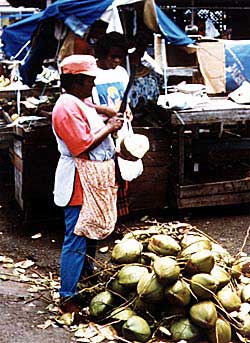
In Market Square, machetes flash in the sun, as farmers slash open green coconuts. Coconut water: 50¢. Other merchants hawk exotic spices, fruits and vegetables. As I watched one morning, a small hand tugged on mine. "My name is Camellia. Come see what my mother has made," my 12-year-old captor said, her sparkling eyes laughing over chocolate cheeks.
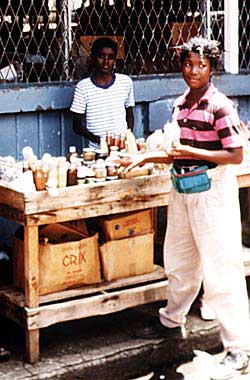 "Smell this," she ordered, opening a bottle of home-made vanilla extract. Then, without a breath: "This is bay leaves. It takes care of gas. Can I show you how to shave nutmeg? Do you like cinnamon?"
I left with a bottle of hot sauce that could strip paint.
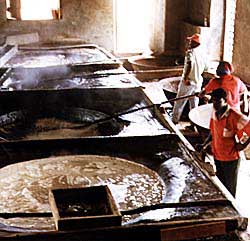
At the Dougaldston Estate, gentle breezes carry scents of nutmeg, vanilla, cinnamon and cloves. Outside, a solitary woman, her face cracked from the sun, shuffles silently through a bin of cocoa beans, turning them so they dry evenly. In Gouyave, rows of women sort and process sacks of nutmeg within a local cooperative. At the River Antoine Rum Distillery, an ancient waterwheel and crusher squeezes juice from sugar cane, the first step in creating one of the island's many rums.
"The only way to starve in Grenada is if you're lazy," goes local reasoning. "Drop a line into the sea, and a fish will take it. Plant a seed, and it will grow."
 During a tour of the capital, I visited the courtyard of Fort George, where smoldering social and political unrest erupted in gunfire and death in October 1983. Rubbing his fingers along a bullet hole in a flag pole, my guide called Grenada "the most peaceful spot on the planet." I noted the irony.
"The irony is that most Americans hadn't heard of Grenada until your military forces' intervention," he said quietly, using the euphemism that has replaced more polarizing terms like invasion and rescue mission. "We were a young nation. But we've turned the page on violence and moved on. How many places can say that?"
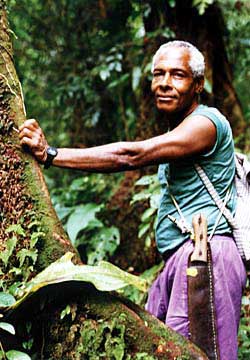 Some of Grenada’s most peaceful settings lie perhaps in its rainforests. "Hear the music," said Telfor Bedeau, my guide for a full-day hike though the mountainous jungles of Grand Etang National Park. Water rushed through rocky stream beds, providing the melody. The wind whistled eerily through the jungle canopy, as palm fronds struck each other in a grinding bass. Coconuts thudded to the ground in counterpoint.
As his machete slashed the overgrowth, Bedeau showed me a pit in the mud where an armadillo had recently rutted and a cave where he’d once awakened a cloud of cranky bats. Overhead, mosses and orchids hung from giant trees. Almost constant rain had made the red clay trail as slick as ice. Climbing, I used roots as handholds. Coming down, I clung to "Tarzan vines" and rappelled. Sometimes I just gave in, sat down and slid. At what Bedeau called "the spine of the island," the path narrowed to shoulders’ width—with a nearly 1,000-foot drop on either side. Wind and rain buffeted us, the result of warmer Caribbean air clashing with cooler air from the Atlantic. After eight hours, we reached Concord Falls, three crashing cascades that marked the end of our journey.
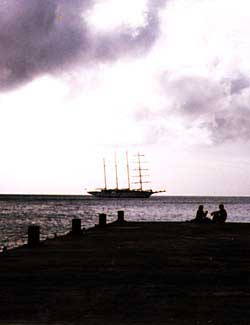 Fortunately, Grenada rewards adventure with luxurious sloth. At the end of each day, I retreated to my villa-like suite and plunged into my private pool. Refreshed, I donned fresh clothing and sandals and strolled down the beach to a West Indian dinner rich with spices and freshly picked fruits. Some evenings, I ate in my private garden, the peacefulness and solitude punctuated only by tiny birds. The gentle roll of the sea lulled me to sleep.
Even less touristed, the tiny island of Carriacou is an easy day-trip from Grenada-if you fly. My 15-minute flight ended on a runway that doubles as the island's main road. By the second day, islanders knew me by name and offered tips on secluded coves and easy hikes. It was the ultimate in laid-back living-all the more reason to opt for the more challenging return by freighter.
As for the cow, when I last saw her, she was perhaps a dozen yards from shore. I could swear she was surfing.
Grenada - If You Go:
Tourism Information
Grenada Tourist Office, 820 Second Avenue, Suite 900D, New York, NY 10017; 800-638-0852.
Getting There
American Airlines offers daily air service to Grenada through Puerto Rico. BWIA flies from New York and Miami.
Lodging
Most deluxe resorts stretch along the white sands of Grand Anse Beach and feature luxury suites with private garden, pool and outdoor eating area. Rates range from $150 off-season to $500 in-season, MAP. Rates for housekeeping cottages range from $100-$160. Guest houses and private rooms are available in and around St. George at $40-$60. (All rates are per night, double occupancy.)
Dining Out
The abundance of spices, fresh seafood, and just-picked fruits and vegetables encourages intense, bold flavoring. My favorite restaurant is La Belle Creole, both for its nouvelle West Indian cuisine and for its hilltop view and engaging service. In St. George's, I especially enjoyed The Nutmeg, known for its harbor view and for the best roti (a spicy roll-up sandwich) in town. Nearby, Mama's draws both the budget-conscious and the curious with island specialties like fried lambi (conch) and shredded crab with lime juice, as well as armadillo and monkey. At Morne Fendue, a West Indian plantation house on the isolated north end of the island, I enjoyed a traditional West Indian buffet lunch with pepperpot, a spicy pork stew that has been simmering for years; the cook just keeps adding more ingredients.
 Getting Around
Car rentals are available, but roads are rugged, narrow, winding and unforgiving. Accidents are commonplace. Taxis are moderately-priced (I found Grencab the most reliable). "Public" transit covers most of the island in the form of private mini-vans that offer pulsing reggae music, a crush of human and occasional animal passengers, and a ride that makes Space Mountain seem tame. Water taxis run between St. George's and the hotels on Grand Anse Beach.
Language
The official language is English, although you're likely to hear unintelligible French patois.
Weather
The climate on Grenada is sub-tropical with an average year-round temperature of 84 degrees. As one of the Windward Islands, Grenada benefits from cooling Atlantic breezes. Rain is frequent, especially in autumn, but rarely long-lasting.
Clothing
Dress is casual, although bathing suits are for beach and pool use only.
 Some of Grenada’s most peaceful settings lie perhaps
in its rainforests. "Hear the music," said Telfor Bedeau, my guide for a
full-day hike though the mountainous jungles of Grand Etang National Park. Water rushed
through rocky stream beds, providing the melody. The wind whistled eerily through the
jungle canopy, as palm fronds struck each other in a grinding bass. Coconuts thudded to
the ground in counterpoint.
Some of Grenada’s most peaceful settings lie perhaps
in its rainforests. "Hear the music," said Telfor Bedeau, my guide for a
full-day hike though the mountainous jungles of Grand Etang National Park. Water rushed
through rocky stream beds, providing the melody. The wind whistled eerily through the
jungle canopy, as palm fronds struck each other in a grinding bass. Coconuts thudded to
the ground in counterpoint.
As his machete slashed the overgrowth, Bedeau showed me a pit in the mud where an armadillo had recently rutted and a cave where he’d once awakened a cloud of cranky bats. Overhead, mosses and orchids hung from giant trees. Almost constant rain had made the red clay trail as slick as ice. Climbing, I used roots as handholds. Coming down, I clung to "Tarzan vines" and rappelled. Sometimes I just gave in, sat down and slid. At what Bedeau called "the spine of the island," the path narrowed to shoulders’ width—with a nearly 1,000-foot drop on either side. Wind and rain buffeted us, the result of warmer Caribbean air clashing with cooler air from the Atlantic. After eight hours, we reached Concord Falls, three crashing cascades that marked the end of our journey.
 Fortunately, Grenada rewards adventure with luxurious
sloth. At the end of each day, I retreated to my villa-like suite and plunged into my
private pool. Refreshed, I donned fresh clothing and sandals and strolled down the beach
to a West Indian dinner rich with spices and freshly picked fruits. Some evenings, I ate
in my private garden, the peacefulness and solitude punctuated only by tiny birds. The
gentle roll of the sea lulled me to sleep.
Fortunately, Grenada rewards adventure with luxurious
sloth. At the end of each day, I retreated to my villa-like suite and plunged into my
private pool. Refreshed, I donned fresh clothing and sandals and strolled down the beach
to a West Indian dinner rich with spices and freshly picked fruits. Some evenings, I ate
in my private garden, the peacefulness and solitude punctuated only by tiny birds. The
gentle roll of the sea lulled me to sleep.
Even less touristed, the tiny island of Carriacou is an easy day-trip from Grenada-if you fly. My 15-minute flight ended on a runway that doubles as the island's main road. By the second day, islanders knew me by name and offered tips on secluded coves and easy hikes. It was the ultimate in laid-back living-all the more reason to opt for the more challenging return by freighter.
As for the cow, when I last saw her,
she was perhaps a dozen yards from shore. I could swear she was surfing.
Grenada - If You Go:
Tourism Information
Grenada Tourist Office, 820 Second Avenue, Suite 900D, New York, NY 10017; 800-638-0852.
Getting There
American Airlines offers daily air service to Grenada through Puerto Rico. BWIA flies from
New York and Miami.
Lodging
Most deluxe resorts stretch along the white sands of Grand Anse Beach and feature luxury
suites with private garden, pool and outdoor eating area. Rates range from $150 off-season
to $500 in-season, MAP. Rates for housekeeping cottages range from $100-$160. Guest houses
and private rooms are available in and around St. George at $40-$60. (All rates are per
night, double occupancy.)
Dining Out
The abundance of spices, fresh seafood, and just-picked fruits and vegetables encourages
intense, bold flavoring. My favorite restaurant is La Belle Creole, both for its nouvelle
West Indian cuisine and for its hilltop view and engaging service. In St. George's, I
especially enjoyed The Nutmeg, known for its harbor view and for the best roti (a spicy
roll-up sandwich) in town. Nearby, Mama's draws both the budget-conscious and the curious
with island specialties like fried lambi (conch) and shredded crab with lime juice, as
well as armadillo and monkey. At Morne Fendue, a West Indian plantation house on the
isolated north end of the island, I enjoyed a traditional West Indian buffet lunch with
pepperpot, a spicy pork stew that has been simmering for years; the cook just keeps adding
more ingredients.
 Getting
Around
Getting
Around
Car rentals are available, but roads are rugged, narrow, winding and unforgiving.
Accidents are commonplace. Taxis are moderately-priced (I found Grencab the most
reliable). "Public" transit covers most of the island in the form of private
mini-vans that offer pulsing reggae music, a crush of human and occasional animal
passengers, and a ride that makes Space Mountain seem tame. Water taxis run between St.
George's and the hotels on Grand Anse Beach.
Language
The official language is English, although you're likely to hear unintelligible French
patois.
Weather
The climate on Grenada is sub-tropical with an average year-round temperature of 84
degrees. As one of the Windward Islands, Grenada benefits from cooling Atlantic breezes.
Rain is frequent, especially in autumn, but rarely long-lasting.
Clothing
Dress is casual, although bathing suits are for beach and pool use only.