
 Famous Faces, Famous Places and Famous Foods

The Kettle Valley Railroad by Bicycle
The air felt wet and heavy. Gone was the torture of the scorching sun that zapped our energy like no hill or mountain ever could. A South African friend and I had completed the first leg of our more than 400-kilometer bicycle journey on the bed of an abandoned railway and sat exhausted and demoralized at the Chute Lake Lodge.
Chute Lake is a rustic resort on the stretch of the Kettle Valley Railway from Midway to Penticton, British Columbia. Although, the train tracks have long since been sold for scrap metal, outposts like this are still popular with the locals.
 Riding from Kelowna had been a mistake. The smell of burning car brakes at the bottom of the steep dirt access road had been an omen we had chosen to ignore. Our punishment was a mountain road too steep to ride. Eighty pounds of gear was too heavy to peddle up, and every footstep seemed to slide backward on the loose rocks. Now rain threatened to further dampen our spirits.
We explored a large shed whose walls were open on two sides. Red carpet covered the bare earth floors, the past condensed and stuffed into every inch of this unlit eyesore. Ad campaigns of yesteryear covered the walls. Old household and logging tools and gadgets that we could not identify littered the ground and hung from the ceiling. An old car sat in the corner, motionless for decades. The darkness crept in, signifying the end of the era the clutter once represented. We hurried through. There was no electricity to keep the night at bay. The historic wooden lodge was also of another generation, and like the shed, stuffed with artifacts.
We were up and raring to go at the crack of dawn. The clouds hung heavy and the race was on. So was the race against Mother Nature, already on her way with rain and wind. We set off downhill to Penticton. The railway looped down and around through tunnels and over small bridges. Trains can only handle minor grades, so the railway had to be built almost level to handle these steam behemoths. The sun was shining brilliantly when we got to Penticton. We had escaped Mother Nature’s fury, so we stopped to feast on her spoils. A fruit stand stood at a crossroads. The smell of fresh muffins and pie wafted down the road to greet us. The friendly couple who manned the booth had added a little kitchen where they baked country-style goodies with fresh Okanagan fruit and laid out a breakfast fit for kings: ice cream, peaches, pies and muffins. But we could not linger all day, as downtown Penticton awaited.
Penticton was abuzz with the lead up to the Ironman Triathlon. Athletes from around the globe had come to compete against the best. We felt strangely outclassed, our mountain bikes weighted down with gear, while their slick two-wheelers were streamlined for speed and efficiency. After exploring this beautiful town we stopped at a RV park for lunch. In the middle of a rather juicy peach, I looked across the beach to witness a patio umbrella circling above the trees. Beach toys were being sucked up into the sky before drifting out on to the lake several kilometers away. It seemed that Mother Nature had sent us a small twister as a reminder of her awesome power. Awnings were ripped off several RVs, and a tree snapped in half before the storm's fury settled to peace and calm. That night we camped in the safety of Osoyoos.
The next day we faced our last major challenge. A 20-kilometer steep highway climb to Anarchist Summit. Fully loaded trucks take up to an hour and a half to pull this grade. Ascending, we could see the cars switch-backing above and below us. The view was spectacular, and the rocks radiated the heat back to us. It took four hours with several breaks to complete this stretch of grueling torture. For thrills, we would see how many trucks we could convince to toot their horns. The cars, for the most part, stayed their distance. One motorcyclist took pity on us and stopped and chatted for a good half-hour.
Once we finally reached Anarchist Summit, we saw a sign advertising fresh-baked goods at a bed and breakfast inn. We stopped, famished and thirsty. Our water had run out several kilometers back. Although the owner only baked on weekends, she brought out cupcakes and Gatorade. We chatted on her comfy porch while a bird fed its young in the overhang above us. The owner was very kind and would not accept any payment other than our gratitude.  On we rode, over the summit, through farm country, and down into the Kettle Valley where we joined the railway once more. Local residents have put up incredible resistance against using the Kettle Valley as part of the Trans Canada Trail. They erected 8-foot high electric fences to keep cyclists out. Angry farmers tried to run us off their property. Objections aside, the government has established parks to commemorate the railway and intends to turn the old railway bed into a major recreational facility and tourist attraction. Local police questioned us about problem farmers.
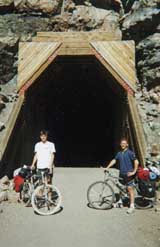
The Kettle Valley Railway stretches out relatively flat and straight, despite the mountain elevations. Some stretches have become roads. Bridges have been moved, or demolished, while logging trucks create horrendous washboard in spots. One particularly long stretch of very dark tarmac has a rather interesting rest stop. Old railway signs lead to tables, hammocks and a shelter. Railway paraphernalia hang from ceilings and posts. An old fire bell was attached to a post with a small hammer hanging beside.
The bell made a strange clang when we struck it. As if summoned, an old man hurried down the staircase towards us. In his hand was a bottle of cold water and a little book. A chubby dog ran ahead to greet us. The man moved too fast and was too agile for his years. We looked at each other, puzzled. The man insisted we empty our water bottles and fill them with fresh cold water. Sheesh, what a request! He sat us down, and told us the history of the railway and how he, as a young boy, was part of it. He moved on to show us the original engineering specifications of the railway. Finally, he made us sign our names with markers on the shelter. We were numbers 1101 and 1102, already double last year's total. He had greeted and counted every single cyclist that had stopped. His dreams of expanding the shelter and possibly adding a caboose were beginning to materialize. He was going to be ready for even more cyclists next year. Lastly, he told us he was among the soldiers who landed in Normandy during the invasion and sent us on to his nephew's campground up the road. What a guy!
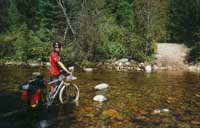 The next day, after fording a small stream, we rode up into the mountains on a 1-% grade. The views were spectacular and no major detours or hassles deterred us for 80 kilometers. On the way, we saw several old train stations and the historic town of Beaverdell, home to the longest continually operated hotel in British Columbia. Beaverdell’s other claim to fame is home to the "horny black beaver." We were afraid to ask what that meant. After enjoying the little restaurants that dot this very small town, we slept at McCulloch Lake.
The last day brought us to the most spectacular part of our journey. The 18 trestles and two tunnels of Myra Canyon stretch over 12 kilometers. Although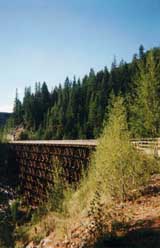 very touristy, and missing the authenticity of the less-visited stops along the trail, the canyon was still incredible. In previous years, several people had plummeted off the trestles while attempting to ride across. Now there are handrails and boardwalks to prevent mishaps. There is still a very real danger of plunging into the abyss on the less popular trestles where there are no handrails.
Tired, we descended back to our car. The roundtrip had taken four days and we had traveled over 400 kilometers by bike.
For More Information
Tourism B.C. 1-800-HELLO BC or www.travel.bc.ca
Penticton Visitor’s Information Center
Kelowna Visitor’s Information Center
Tyson is a resident of West Vancouver where he enjoys mountain biking on local trails.
On we rode, over the summit, through farm country, and
down into the Kettle Valley where we joined the railway once more. Local residents have
put up incredible resistance against using the Kettle Valley as part of the Trans Canada
Trail. They erected 8-foot high electric fences to keep cyclists out. Angry farmers tried
to run us off their property. Objections aside, the government has established parks to
commemorate the railway and intends to turn the old railway bed into a major recreational
facility and tourist attraction. Local police questioned us about problem farmers.
The Kettle Valley Railway stretches out relatively flat and straight, despite the mountain elevations. Some stretches have become roads. Bridges have been moved, or demolished, while logging trucks create horrendous washboard in spots. One particularly long stretch of very dark tarmac has a rather interesting rest stop. Old railway signs lead to tables, hammocks and a shelter. Railway paraphernalia hang from ceilings and posts. An old fire bell was attached to a post with a small hammer hanging beside.
The bell made a strange clang when we struck it. As if summoned, an old man hurried down the staircase towards us. In his hand was a bottle of cold water and a little book. A chubby dog ran ahead to greet us. The man moved too fast and was too agile for his years. We looked at each other, puzzled. The man insisted we empty our water bottles and fill them with fresh cold water. Sheesh, what a request! He sat us down, and told us the history of the railway and how he, as a young boy, was part of it. He moved on to show us the original engineering specifications of the railway. Finally, he made us sign our names with markers on the shelter. We were numbers 1101 and 1102, already double last year's total. He had greeted and counted every single cyclist that had stopped. His dreams of expanding the shelter and possibly adding a caboose were beginning to materialize. He was going to be ready for even more cyclists next year. Lastly, he told us he was among the soldiers who landed in Normandy during the invasion and sent us on to his nephew's campground up the road. What a guy!
 The next day, after fording a small stream, we rode up into the mountains on a
1-% grade. The views were spectacular and no major detours or hassles deterred us for 80
kilometers. On the way, we saw several old train stations and the historic town of
Beaverdell, home to the longest continually operated hotel in British Columbia.
Beaverdell’s other claim to fame is home to the "horny black beaver." We
were afraid to ask what that meant. After enjoying the little restaurants that dot this
very small town, we slept at McCulloch Lake.
The next day, after fording a small stream, we rode up into the mountains on a
1-% grade. The views were spectacular and no major detours or hassles deterred us for 80
kilometers. On the way, we saw several old train stations and the historic town of
Beaverdell, home to the longest continually operated hotel in British Columbia.
Beaverdell’s other claim to fame is home to the "horny black beaver." We
were afraid to ask what that meant. After enjoying the little restaurants that dot this
very small town, we slept at McCulloch Lake.
The last day brought us to the most spectacular part of our journey. The 18 trestles
and two tunnels of Myra Canyon stretch over 12 kilometers. Although very touristy, and missing the authenticity of the less-visited stops along
the trail, the canyon was still incredible. In previous years, several people had
plummeted off the trestles while attempting to ride across. Now there are handrails and
boardwalks to prevent mishaps. There is still a very real danger of plunging into the
abyss on the less popular trestles where there are no handrails.
Tired, we descended back to our car. The roundtrip had taken four days and we had traveled over 400 kilometers by bike.
For More Information
Tourism B.C. 1-800-HELLO BC or www.travel.bc.ca
Penticton Visitor’s Information Center
Kelowna Visitor’s Information Center
Tyson is a resident of West Vancouver where he enjoys mountain biking on local trails.